Flying with little ones
First Flight With Baby: A Checklist From Booking to Bedtime
Start with the decisions that would be difficult to fix at the airport: your baby’s documents, a suitable seating arrangement, feeding supplies and a…
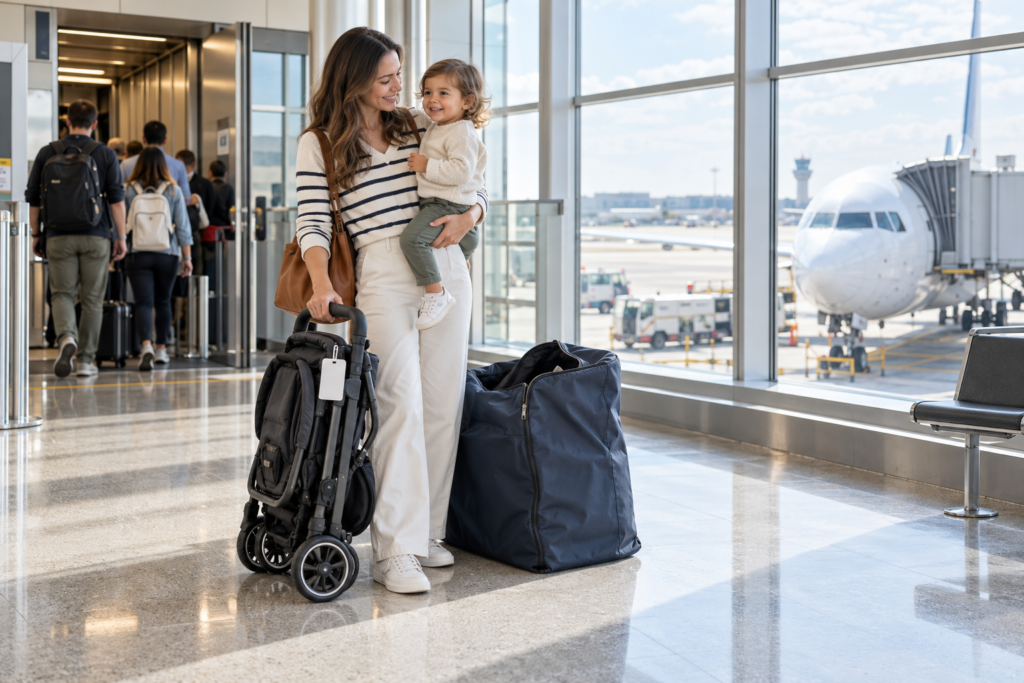
Gate checking a stroller lets you keep it through the airport until the airline collects it near boarding. The stroller then travels in the aircraft’s hold. Where you collect it after landing depends on the airline, airport and arrangements made when you hand it over.
Before accepting the tag, ask two questions: “Where will I collect this stroller?” and “Will it be available during my connection?” Keeping it until departure does not automatically mean getting it back at the next aircraft door.
Here is how to prepare your stroller, handle the handover and plan for the part of the journey when it is out of reach.
Instead of leaving your stroller at the ticket counter, you take it through security and use it in the terminal. Before boarding the aircraft, you fold it and hand it over at the location airline staff specify.
Gate checking is different from taking a stroller into the cabin. A gate-checked stroller travels in the hold; an accepted cabin stroller stays onboard in an approved storage space.
| Option | When you hand over the stroller | What to confirm |
| Ticket-counter check | Before going through security | Collection location and how you will carry your child through the terminal |
| Gate check | Near boarding, at the designated handover point | Tagging, folding instructions and return location |
| Cabin carriage | You bring an approved folded stroller onboard | Airline acceptance, folded dimensions and available storage |
A stroller described by its manufacturer as “cabin size” still needs to meet your airline’s requirements for the flight.
Several major U.S. airlines allow eligible strollers to be checked without a stroller fee when you travel with a child. Their rules differ on which equipment qualifies and where it can be handed over.
For example:
Check the policy of the airline operating each flight. If your stroller has an unusual design, send the airline its model name, weight and folded measurements before travelling.
Practice folding the stroller and engaging its transport lock. If you plan to use a travel bag, check that the stroller fits inside with the parts you intend to leave attached.
You should be able to complete the fold without searching for instructions while your boarding group waits behind you.
Photograph the stroller before the trip, including its frame, wheels and any existing marks. Keep the model details and proof of purchase somewhere accessible.
If you are checking other luggage, use that opportunity to confirm that your stroller can go to the gate.
Ask:
For a connection, name the intermediate airport when asking about collection. “Will I get it back?” leaves room for confusion about which stop you mean.
In the United States, the stroller must be screened. TSA instructs travellers to remove children from strollers for screening. Strollers and their contents go through the appropriate screening process; equipment too large for the X-ray machine receives an alternative inspection. Follow the officer’s instructions at the checkpoint.
Keep the basket easy to empty. Loose toys, food containers and jackets create extra items to gather while you are also settling your child.
Visit the desk when an agent is available, rather than waiting until you reach the aircraft door.
Confirm the stroller’s tag, handover point and return arrangements. Keep any claim receipt provided, and photograph the tag while its details are readable.
If you need the stroller during a layover, raise that request now.
Before folding, empty the basket and storage pockets. Move feeding supplies, nappies, medication, documents and valuables into the bag you will carry onboard.
Remove loose accessories where the manufacturer allows, such as a detachable cup holder or clip-on toy. Secure straps and other parts according to the stroller’s transport instructions.
Do this while you still have space at the gate. The aircraft doorway is a difficult place to discover that your boarding pass is underneath the seat liner.
Take your child out before folding. Engage the folding lock, put the stroller in its bag if using one, and follow staff instructions about tag placement.
Do not leave it unattended simply because other families have placed equipment nearby. Make sure you are using the designated collection point.
Confirm the return point before departure. It may be near the aircraft, in the jet bridge, at a baggage carousel or at a separate oversized-baggage collection point.
Southwest provides a useful example of why this matters. Its published policy says gate-checked child equipment is collected at baggage claim at the final destination. Passengers who prefer collection at the jet bridge in a connecting city or at their destination should tell the agent when gate checking. Make the request and confirm the arrangements for your journey.
After landing, follow the crew’s directions. If the agreed return point is unclear, ask a member of staff before leaving the arrival area.
Keep the claim receipt until you have collected and checked the stroller.
A connection adds a separate decision: do you want the stroller during the layover, and can the airline make it available there?
Ask the agent to explain what will happen at each stop:
If the stroller is being sent through to your final destination, plan to manage the connecting terminal without it.
Build your plan around the possibility that the stroller will not be immediately available. A suitable baby carrier may help you move through the terminal while keeping a hand free for luggage.
Tell airline staff if you are waiting for the stroller and your onward flight is close to boarding. Ask for instructions rather than leaving without knowing whether it is being returned to you.
Request stroller access at the connecting airport before handing it over on the first flight. A long wait can make a stroller useful for terminal walks and resting between activities, but the collection arrangement needs to be confirmed.
Check both operating airlines’ policies. Acceptance on the first flight does not establish the rules for the next one.
This is particularly useful when one booking includes flights operated by different carriers.
A travel bag can keep loose parts together and provide a barrier against dirt and scuffs. A thin fabric cover offers little cushioning, while a padded bag adds weight and takes more effort to pack.
Choose a bag that:
Follow the manufacturer’s instructions about removing wheels or other components. Avoid dismantling parts at the gate unless you already know how to store and reattach them.
A bag cannot guarantee that a stroller will arrive undamaged. It also does not change the airline’s liability terms. Southwest, for example, states that strollers and child-restraint systems travel under a limited release of liability.
Choose according to how much you need the stroller inside the airport and how manageable it is at boarding.
Gate checking may suit you if you have a long terminal walk, your toddler cannot comfortably walk the distance, or you want to keep using the stroller until boarding.
Counter checking may suit you if the airline requires it for your model, you have a suitable alternative for carrying your child, or handling the folded stroller at the gate would be difficult.
Cabin carriage may suit you if the airline accepts your folded stroller and you can lift and store it while managing your child.
For more on folded measurements and features, see our guide to cabin-size travel strollers.
First, check with staff that you are at the correct collection point. A stroller missing from the jet bridge may have been sent to baggage claim.
If it still cannot be located, contact the airline’s baggage service before leaving the airport where practical. Have your tag receipt and flight details ready.
If it arrives damaged:
Inspect the frame, wheels, brakes and folding lock before putting your child back in. If a part appears unsafe, arrange another way to transport your child until the stroller has been assessed.
Before handing over the stroller, check that:
Often, eligible strollers can be used through the terminal and handed over near boarding. The airline determines the exact handover point, so confirm where to fold and leave yours.
That is not guaranteed. Ask where it will be returned before handing it over, and check the instructions again after landing if necessary.
Eligibility depends on the airline and the stroller’s size, weight and design. Give the airline your exact model details rather than assuming that all double strollers follow the same rule.
Check the airline’s allowance and handover rules for both items. American’s published children’s policy, for example, allows one item at the gate and the other at the counter when travelling with both.
Empty it before handover. Keep cabin essentials with you, and ask the airline how any additional items must be checked. Do not treat the stroller basket or travel bag as an extra luggage allowance.
There is no single requirement covering every airline and stroller. Check your carrier’s packing instructions. A suitable bag can help contain parts, but it does not guarantee protection from handling damage.
Check whether your current stroller is accepted before buying another one. Consider its folded size, how easily you can carry it and whether you can manage the handover while travelling with your child.
Start with the decisions that would be difficult to fix at the airport: your baby’s documents, a suitable seating arrangement, feeding supplies and a…
The honest guide to the hardest flying age — and the strategy that makes it manageable.
The bulkhead bassinet is the best free upgrade in family travel — if you know how to get it.