Flying with little ones
Flying With a Toddler: Surviving 1–3 Year Olds on a Plane
The honest guide to the hardest flying age — and the strategy that makes it manageable.
Start with the decisions that would be difficult to fix at the airport: your baby’s documents, a suitable seating arrangement, feeding supplies and a safe ride after landing. Count the feeds, changes and clothing you may need before your next reliable opportunity to buy supplies. Include the drive, airport waits and destination transfer in that calculation.
For a first flight with baby, a useful checklist also tells you when to act. The stages below help you settle booking questions early, keep daily care manageable in transit and finish the trip with a suitable sleep space ready.
| Decision | What to settle |
|---|---|
| Health | Discuss the proposed trip with the clinician if your baby is very young or has medical needs. |
| Documents | Arrange infant paperwork and check the reservation details. |
| Seating | Confirm the restraint, its acceptance and any bassinet request. |
| Cabin supplies | Work out feeding and changing needs through the entire journey. |
| Screening | List the checkpoints on the outward and return journeys, then review their local procedures. |
| Equipment | Establish handover, tagging and collection arrangements. |
| Arrival | Arrange the ride from arrivals and check the crib or cot you will use at the accommodation. |
Before relying on an airline’s age threshold, distinguish its booking rule from advice about your baby’s health. Acceptance of the reservation is not a medical assessment.
Where travel can wait, the American Academy of Pediatrics suggests allowing roughly two to three months before a baby’s first flight. Its advice reflects, in part, the infection exposure associated with airports and air travel. Discuss an earlier departure with your baby’s clinician.
Prematurity and continuing medical needs deserve individual advice. The CDC’s family travel guidance specifically calls for consultation before flying with a child who has chronic heart or lung disease or sickle cell disease.
For an international journey, arrange your baby’s passport, then check the entry and transit requirements that apply to their nationality. Include the return dates when reviewing document validity. Review the baby’s own document requirements alongside those of the adults in the booking.
Prepare a document folder containing:
The U.S. Department of State notes that some countries ask for notarized permission from an absent parent or evidence of sole custody. Its advice also includes carrying evidence that identifies your legal relationship with the baby. For a trip with one parent, review the destination’s consent requirements while gathering these documents.
On U.S. domestic trips, TSA does not require a baby traveling with an adult to show identification at its checkpoint. Separately, contact the carrier about any proof it needs to establish the infant’s age.
If you intend to bring an approved car seat into the cabin, plan to book an aircraft seat for the baby and confirm that the carrier accepts the restraint. A lap-infant reservation is a different arrangement and does not provide the same protection.
For passengers younger than two, FAA guidance identifies an approved child restraint as the safest seating option on a U.S. aircraft. Holding a baby cannot reliably protect them from unexpected turbulence. The FAA recommends restraint use for the entire flight.
Send the operating airline your car-seat model and approval details. Before buying the infant’s seat, ask it to confirm:
Road approval alone does not establish airline acceptance. The CDC advises checking carrier restrictions when planning restraint use. For a lap-infant booking, obtain that airline’s specific holding and restraint instructions.
A bassinet is an infant cot that an airline may provide at particular seating positions, depending on the aircraft. Availability, size limits and permitted use vary. Ask when the baby must come out and how you will manage if the request cannot be fulfilled. Requesting a cot leaves the separate question of how your baby will be safely restrained to be resolved.
Emirates, for example, accepts bassinet requests during booking and through Manage a Booking, but supplies are limited and the cots have specified dimensions. Before requesting one, obtain the equivalent details from the airline operating your flight.
Add the airport drive, check-in, connection, border formalities and destination transfer to your planning. A nonstop itinerary avoids a second boarding process. A connection may still suit your trip, but examine terminal changes and the time available for feeding and changing.
A departure near a usual nap can be convenient. Treat sleep as a possibility rather than the condition on which the itinerary depends.
Estimate supplies from your baby’s normal routine and the full journey you have mapped. Add a delay allowance you can carry. A fixed diaper count cannot account for different babies, airport waits or the time needed to reach your accommodation.
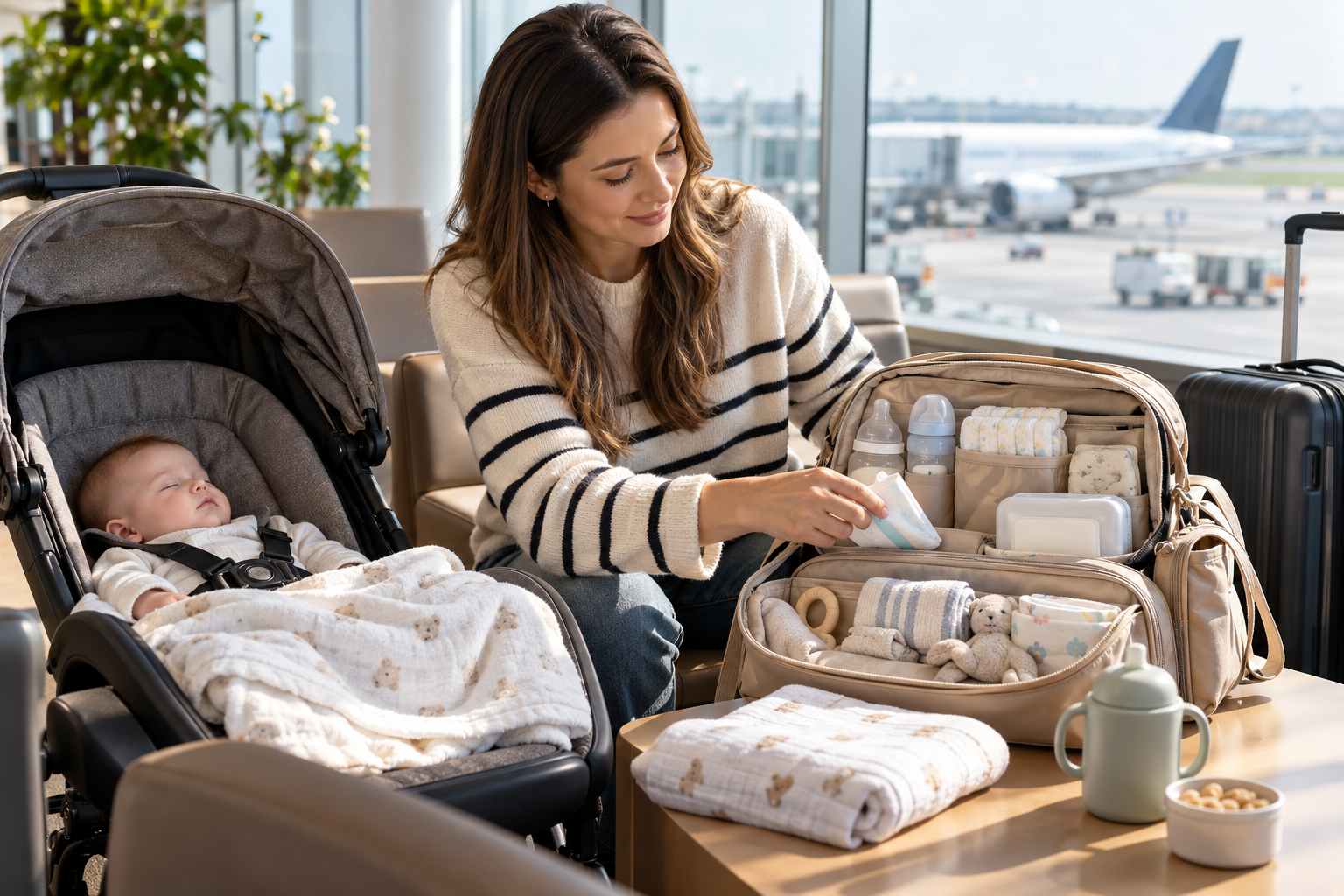
Organize the bag by task. Keep a feeding kit accessible, group the items for one diaper change in a pouch and store replacement clothing together. Check that you can reach each without emptying the bag.
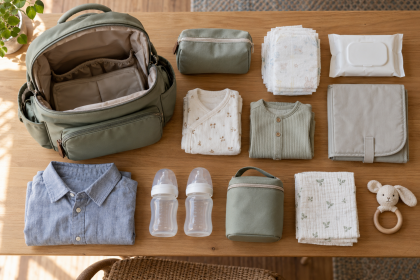
Use equipment and foods already appropriate for your baby:
Decide how feeds will be prepared and stored before you travel. Confirm any service you intend to use on board; refrigeration, hot water or your usual formula should not be assumed available.
Powdered formula can contain germs because it is not a sterile product. CDC preparation advice includes extra precautions for infants under two months, those born early and those with weakened immunity. Ask the clinician how to apply that advice to your itinerary if your baby belongs to one of these groups.
For a prepared bottle kept at room temperature, the CDC sets two limits: use it within two hours of mixing and within one hour from the start of feeding. Throw away milk left after a feed. Preparing every bottle at home does not mean it will remain suitable throughout a long day of travel.
Include diapers, wipes, a portable changing mat and any diaper cream you normally use. Add bags for soiled clothing or discarded diapers. Pack replacement baby clothes, a layer for temperature changes and a spare top for the adult likely to handle feeds.
Keep the small changing pouch replenished. On the aircraft, it lets you take what you need to the lavatory while leaving the larger bag at your seat.
Medication, its instructions and any required supporting documents belong in luggage you can access. A familiar pacifier, if used, and a small toy or book can complete the kit.
If staff take a cabin bag for gate checking, remove the feeding, changing and medication supplies before it leaves your hands. Reaching the destination does not necessarily mean reaching the checked bag immediately.
An exemption for infant feeds is not a worldwide security rule. Review departure, connecting and return airports wherever another screening is expected. The examples below concern the named checkpoints and airports.
| Checkpoint or airport | What its published guidance allows |
|---|---|
| United States: TSA | Infant feeds, including formula, breast milk and baby food, can exceed the usual 3.4-ounce/100-milliliter limit and travel outside the quart-size liquids bag. Declare them and take them out for separate screening. Associated cooling supplies are also permitted. |
| United Arab Emirates: Dubai International | The Dubai Airports exemption covers baby milk and food needed for the trip, outside the ordinary liquid restrictions. |
| Denmark: Copenhagen Airport | The airport baby guide allows baby food, formula and necessary water above 100 milliliters, in amounts needed for the journey. |
| Ireland: Dublin Airport | Under Dublin security guidance, individual liquid containers may hold up to two liters, including baby milk and food. The return airport may use different limits. |
Present feeds so officers can identify and examine them, and follow local instructions for trays or additional checks. A security exemption does not expand the airline’s baggage allowance. Recheck airport guidance close to travel because procedures can change.
Use the arrival time recommended by your airport and airline, with room for the care tasks your family needs. When checking in, settle whether the stroller travels in the cabin, is handed over at the gate or must be checked earlier.
Have staff explain the collection point for every item you hand over and whether a connection changes those instructions. Keep its tag or receipt accessible. Plan around collecting a stroller at the aircraft door only after staff confirm that arrangement.
Also confirm acceptance of the car seat you intend to install aboard. Resolving an equipment question at check-in leaves more time than discovering it while boarding.
After checking the gate and departure information, assess the next practical tasks: does your baby need a feed, a change or a fresh outfit? Refill the changing pouch and move the supplies you expect to use first into easy reach.
Keep feeding responsive to your baby. Saving a needed feed for takeoff can leave them hungry while boarding or taxiing takes longer than expected.
Ask whether the airline offers extra boarding time to fit the car seat, so installation can be completed before the cabin gets busier. If two adults travel, ask staff whether one may board with equipment while the other waits nearby with the baby. A solo parent may need extra time for the entire setup. Choose an arrangement the staff can accommodate and be ready when called.
Install an accepted car seat using its instructions and the carrier’s requirements. Put supplies where they are accessible once baggage has been stowed.
Do not use a wearable carrier as the baby’s aircraft restraint. FAA rules on U.S. flights prohibit its use during ground movement, takeoff and landing. Whether it may be used in cruise is a question for the airline and crew.
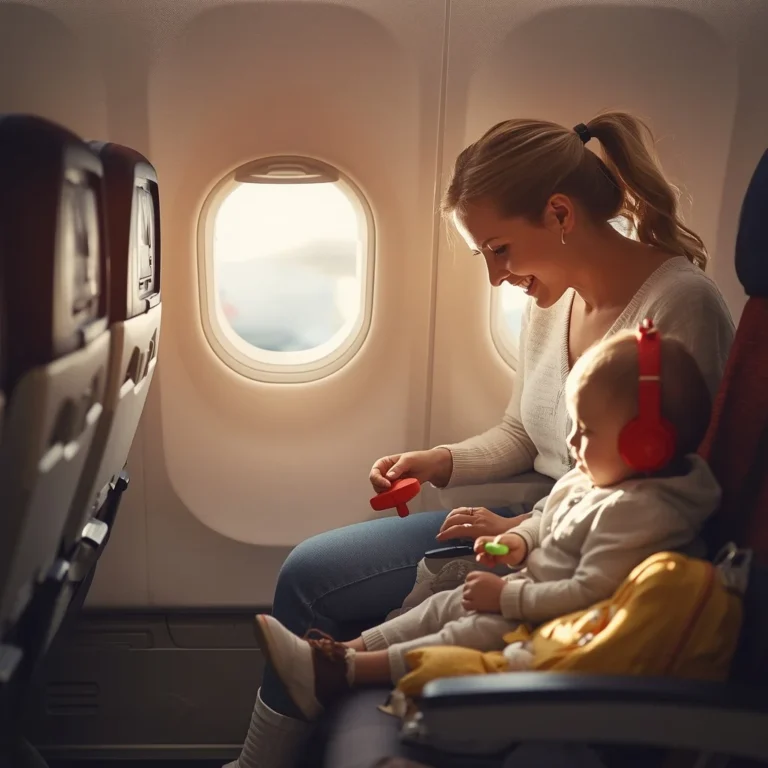
For a bassinet, follow the crew’s directions about taking the baby out for takeoff, landing or turbulence. Plan feeds and comfort around the restraint requirements that apply.
Pressure changes can make ears uncomfortable, particularly as the aircraft descends. Swallowing helps balance middle-ear pressure, so nursing or a bottle may help a receptive infant. A pacifier may also help if your baby already uses one.
Offer these when your baby is awake and interested, within the required restraint arrangement. Timing a feed is not a reason to release a baby from a required restraint.
Consult the clinician before travel after an ear infection or ear surgery. The CDC reports no demonstrated benefit from antihistamines or decongestants for flight-related ear discomfort.
When your baby becomes unsettled, work through hunger, a wet diaper, temperature and tiredness. Locate the lavatory’s changing facility with the crew’s help before bringing your kit. Keep one hand in contact with your baby as you replace the diaper.
Crying can happen despite careful preparation. Tell a crew member if your baby’s condition concerns you rather than trying to manage the concern alone. The AAP cautions against medication intended to make a baby sleep unless the child’s clinician advises it.
Before leaving your seat, check for documents, feeding items and belongings in the surrounding storage spaces. Collect checked equipment at the confirmed location and examine it before use. Report visible damage and seek assistance if its condition concerns you.
For another flight, locate the next gate and check the boarding time before taking a longer break. Reassess the milk, clean equipment, diapers and clothing still available.
For a car journey, confirm an infant seat appropriate to your baby’s size. Ask about the actual model and installation; a provider’s general promise of a child seat leaves important details unresolved. Save the meeting point and contact information where you can access them without a mobile connection.
When comparing airport transfers with a baby, consider how a booked ride, your own car seat or public transport fits the route and equipment you are carrying.
Inspect the supplied crib or travel cot for damage, correct assembly and a snugly fitting mattress intended for it. AAP sleep guidance calls for a firm, flat surface without an incline, with the baby placed on their back. Use a fitted sheet and leave pillows, loose bedding and soft toys out.
If the transfer ends with your baby asleep in a car seat, move them to a suitable sleep space. The AAP advises that car-seat sleep should end when the travel itself ends.
Keep the period after check-in free of fixed activities so you can attend to a feed or diaper change and settle the baby for rest. Arriving at the airport is not the end of your baby’s journey.
Your baby’s first flight does not need a perfect nap or a silent cabin to go well. A delayed departure is easier to manage when the documents are ready, the baby’s seating is settled, care supplies are within reach and the ride from arrivals has been arranged.
Once those are in place, respond to the baby and the journey in front of you. A changed outfit or an extra feed is something the bag should accommodate, rather than evidence that the plan has failed.
The honest guide to the hardest flying age — and the strategy that makes it manageable.
The bulkhead bassinet is the best free upgrade in family travel — if you know how to get it.
Baby feeds are exempt from the liquid rules — here is how screening actually works.