Trips & logistics
Road Trips With a Baby: Naps, Stops and Sanity
Drive the naps, stop properly, and cap the day: the road trip method.
How to plan a road trip is a question with a simple answer and a long checklist. The simple answer: decide the route, decide how far you will drive each day, plan the stops, prep the car, sort the sleep, and pack once. The long checklist is everything that goes wrong when one of those six is skipped — a missed hotel, a dead phone, a boot that will not close, or a second day that starts exhausted because the first day drove too far.
This guide walks through the six steps in order, so the plan is built before the bags are packed. It is written for a family trip, but the steps are the same for any road trip: the only thing that changes with a baby or toddler on board is how much slack the plan needs.
Every road trip has a shape, and the shape decides everything else. A loop starts and ends at home, with a different road back. A one-way trip ends somewhere else, which means a flight, a train, or a second driver home. An out-and-back drives the same road twice, which is simpler but means the return day is a repeat. Decide the shape first.

Then pick the route itself. The fastest road is rarely the best road trip: a motorway gets you there, a scenic road is the trip. A good plan mixes both — the scenic road for the days that are about the drive, the fast road for the days that are about arriving. Plot the whole route on a map before you book anything, and check it against the number of days you actually have. If the route needs more days than the holiday, cut a stop, not a sleep.
The most common road trip mistake is planning the driving like a delivery schedule. Four to six hours of driving a day is a comfortable planning limit for most families — enough to cover real distance, short enough to arrive with energy left. More than that, and the trip becomes the drive: tired drivers, restless passengers, and a hotel room that is only good for sleeping.
Work backwards from the arrival time, not forwards from the departure. If you want to reach the hotel by late afternoon, subtract the driving hours, the fuel stops, and the lunch stop, and that is your real departure time. Add an hour of slack for every day with a baby or toddler on board — a road trip with a baby runs on feeding and nap schedules, not on the map’s arrival estimate.
Stops are not breaks from the plan; they are the plan. Mark three kinds of stops on the route before you leave: fuel stops, food stops, and stretch stops. Fuel is the easy one — never let the tank drop below a quarter on an unfamiliar road. Food is the one people forget — a town with one cafe that closes at three is not a lunch plan. Stretch stops are the ones that keep the trip pleasant: a park, a viewpoint, or a services area with room to walk, every two to three hours.
For each overnight stop, know the answer to one question before you drive: where exactly are you sleeping tonight. A town name is not a plan; a booked room, an address, and a check-in time are. If the day’s drive ends in a small town, book ahead — small towns run out of rooms faster than cities do.
Sleep is the part of a road trip that should be decided at home, not at 9 pm in a car park. Book the overnight stops first, then build the driving days around them. That order matters: the hotel fixes the day’s end point, and the day’s end point fixes how far you can drive.
At each stop, check two things beyond the price: parking and the room itself. Parking that costs extra or sits streets away from the hotel is a real cost on a road trip, and a room on a busy road is a bad night after a long drive. If you are staying in a hotel with a baby, check whether the hotel provides a crib before you travel — if it does not, or the cot is a gamble, bring your own. A travel crib that folds into the boot is the bed you control, and it turns any room into the baby’s own room.
A road trip is the wrong time to discover a problem with the car. A week before you leave, check the tyres (pressure and tread), the oil and coolant, the lights, and the windscreen washers. Make sure the spare tyre or repair kit is actually in the car, with the jack, and that you know where it is. None of this is mechanical expertise — it is a half-hour check that turns a breakdown into a delay instead of a disaster.
Then pack the car kit: the documents, a phone charger that works in the car, a torch, water, and a basic first-aid kit. Save the route offline on your phone before you leave — signal disappears exactly where you need the map most. And clean the car before you pack it: a road trip starts with a boot full of bags, and a boot full of last month’s clutter is space you have already lost.
Packing for a road trip is not packing for a flight. There is no weight limit, but there is a space limit, and the rule is the same: one bag per person, packed once. The day bag rides on top — snacks, water, wipes, a change of clothes, chargers, and whatever the baby needs in the next two hours. Everything else goes underneath and stays there until the hotel.
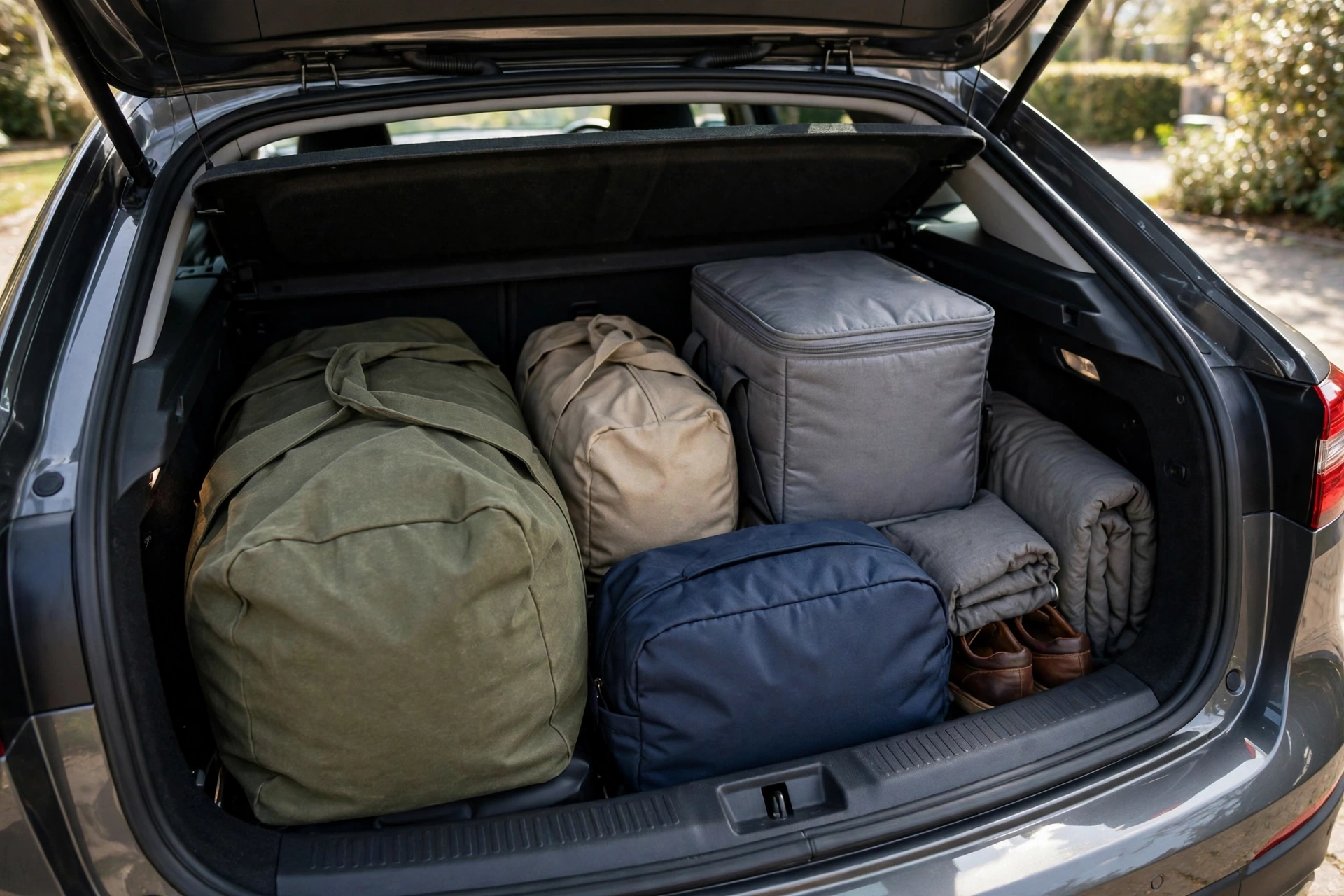
The packing list follows the trip, not the other way round. Clothes for the days plus one spare outfit each, layers for the coldest place on the route, and shoes you can walk in. Food is part of the packing: a cool bag with sandwiches, fruit, and water costs less than three service-station meals and keeps the stops you actually want. For the baby’s kit, the baby travel essentials list is the bag-level companion to this guide, and the travel packing with baby guide covers the three-bag system — flight bag, suitcase, day bag — that works on the road just as well as it works at the airport.
Four to six hours of driving a day is a comfortable planning limit for most families. It covers real distance and still leaves the evening free. Longer days are possible, but they turn the trip into the drive — and with a baby or toddler, add an hour of slack to every day.
Book the overnight stops before you leave, especially in small towns, where rooms run out faster than in cities. Booking ahead also fixes each day’s end point, which is what makes the driving days realistic.
Pull over somewhere safe, call your roadside cover, and let the plan bend. This is why the car check a week before matters — and why the overnight stop should be booked, not guessed: a delayed day still ends in a room, not in a search for one.
A loop is simpler: it starts and ends at home, with a different road back. A one-way trip needs a plan for getting home — a flight, a train, or a second driver. Pick the shape first, then build the days around it.
Plan the day around stops, not around endurance. A stretch stop every two to three hours, snacks in the day bag, and something to look at out of the window beat any single entertainment trick. The drive itself is part of the trip — a scenic road gives everyone something to watch.
The six steps are the same; the slack is different. A road trip with a baby runs on feeding and nap schedules, so the drive days get shorter, the stops get more frequent, and the sleep setup — the baby’s own bed — is decided before you leave, not at the hotel.
Drive the naps, stop properly, and cap the day: the road trip method.
Match the destination to the age and the first trip plans itself.
Five questions before booking decide the whole stay. Here they are.