Flying with little ones
Gate Checking a Stroller: From Check-In to Connections
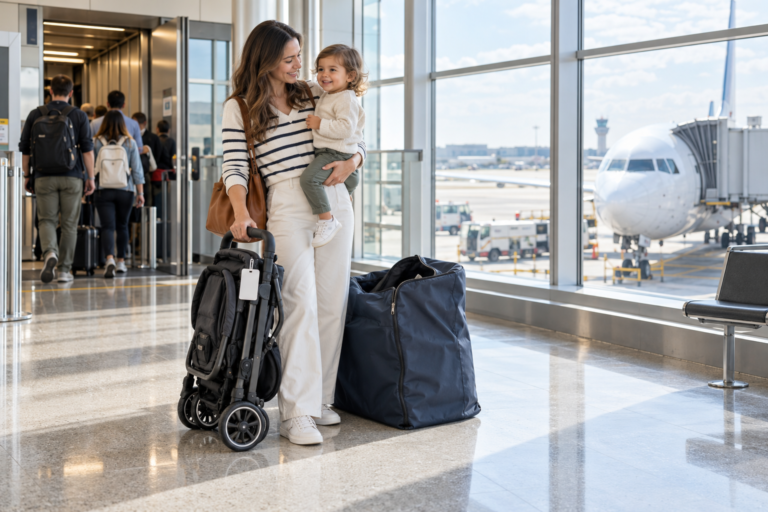
Gate checking a stroller lets you keep it through the airport until the airline collects it near boarding. The stroller then travels in the…
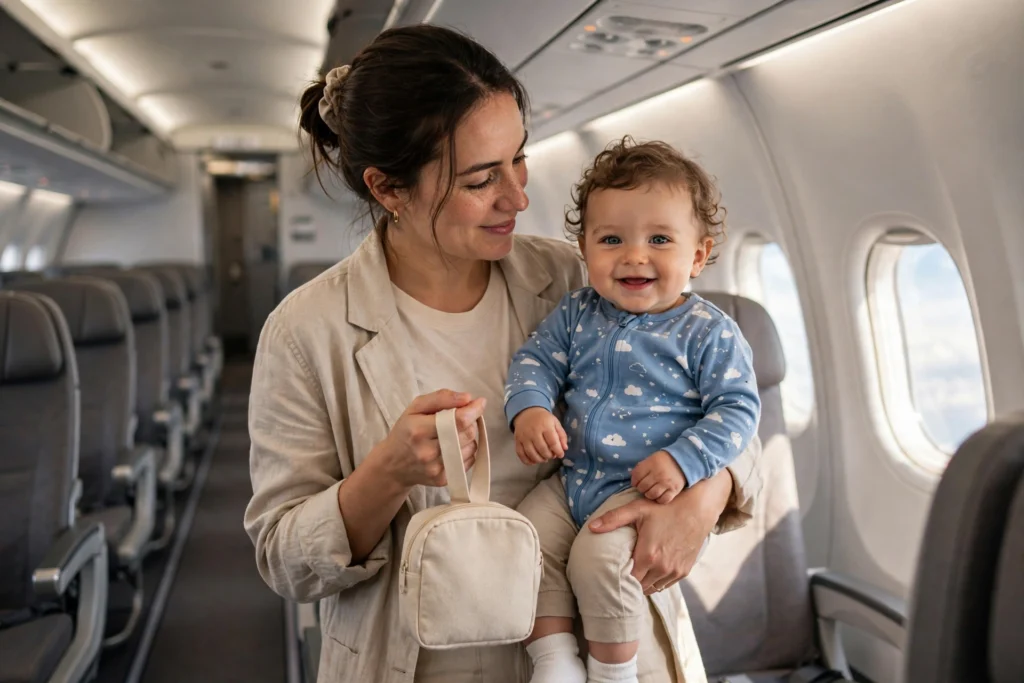
You can change a diaper on a plane, and the airplane lavatory is the place to do it. The usual plan is simple: change your baby at the gate before boarding, carry a small changing pouch onto the plane, and use a fold-down changing table in a lavatory if your aircraft has one. If there is no table, you still have workable options, but they take more care and a slower pace.
A plane lavatory is small, the surface is narrow, and you will be working while the aircraft moves. The aim is not speed for its own sake. It is to keep your baby supported, keep soiled items contained, and leave the space clean for the next person.
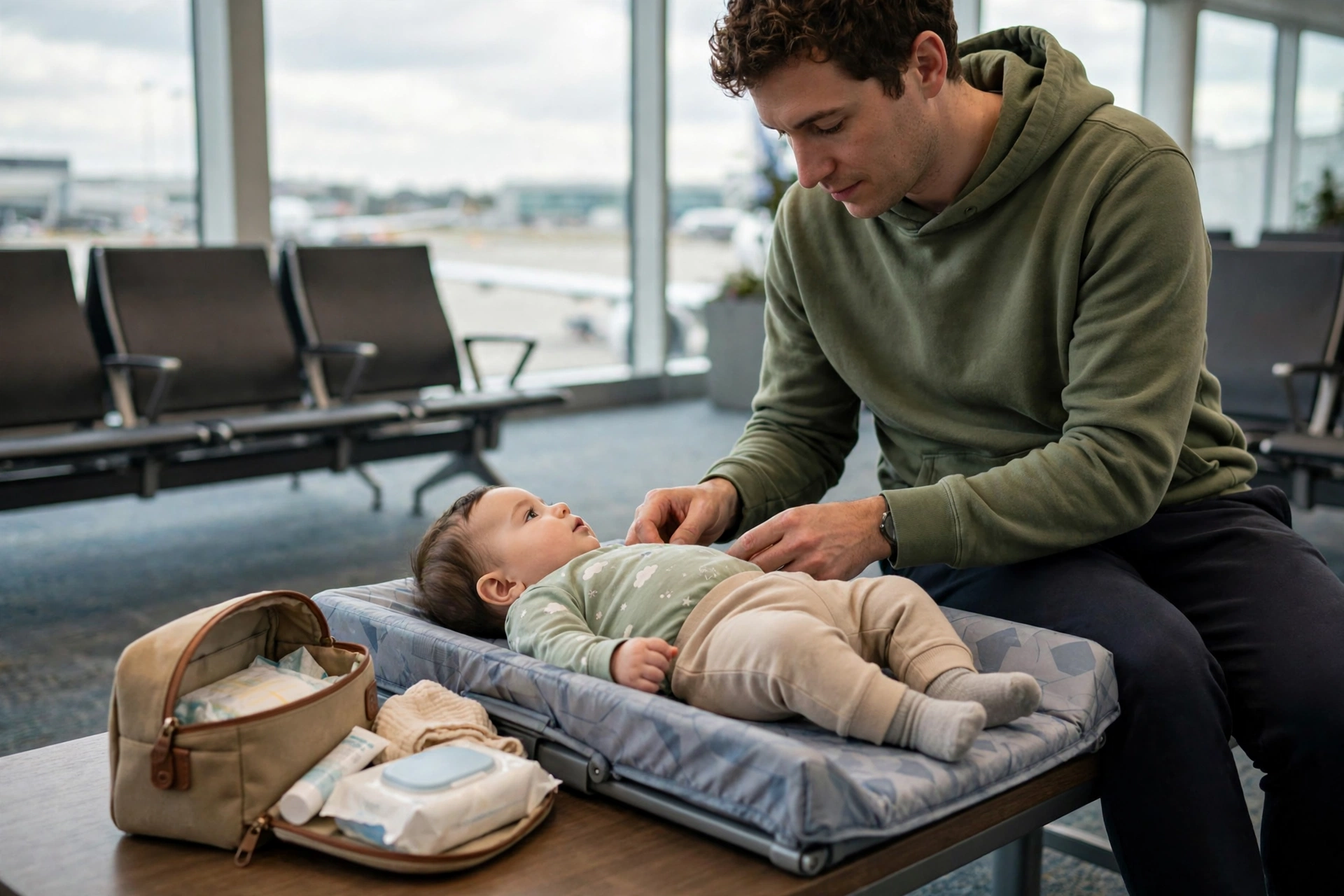
A change at the gate is the easiest change of the trip. It gives you room, a flat surface, and time to check that the new diaper fits well before you are confined to a seat.
The American Academy of Pediatrics advises changing a diaper right before boarding and packing plenty of changing supplies for delays. That advice matters because a delay on the ground can turn into a long wait before you can stand up again in the air.
If this is a first flight with a baby, treat the gate change as part of the boarding routine, rather than something to fit in after you sit down. Check the diaper, check the outfit, and refill the small pouch you will carry onto the plane.
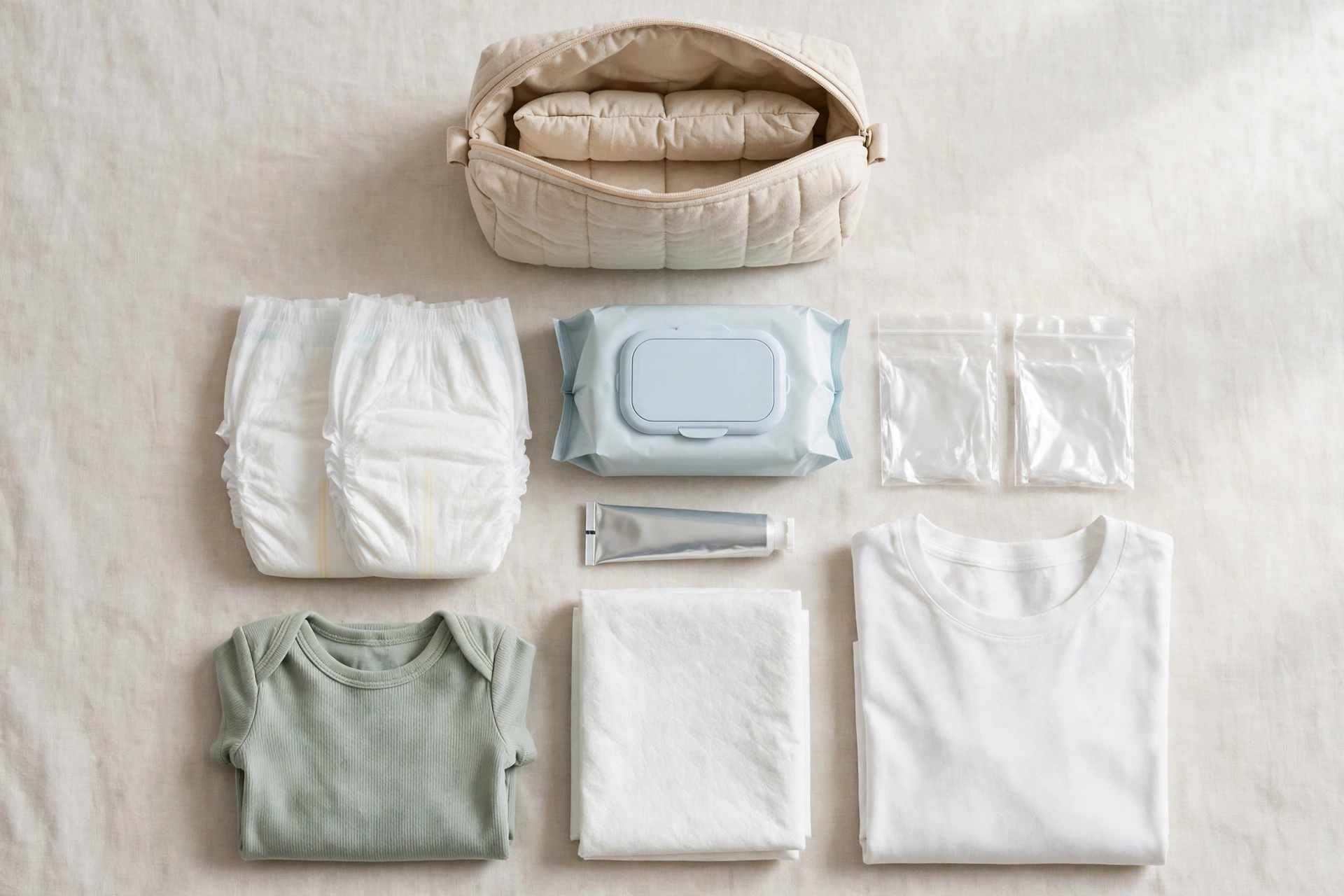
Do not take the whole diaper bag to the lavatory. Take one small pouch that holds everything for a single change, so you are not holding a baby with one hand and looking for wipes with the other.
A practical pouch holds:
Pack it as one small unit, following the same idea as the one-bag diaper bag setup, where the change items stay together in a single pouch. Keep the main bag at your seat. The pouch is the only part that needs to go to the lavatory.
For a longer flight, refill the pouch from the main bag after each change. That way you are never carrying the full supply down a narrow aisle, and you always know what is ready for the next change.
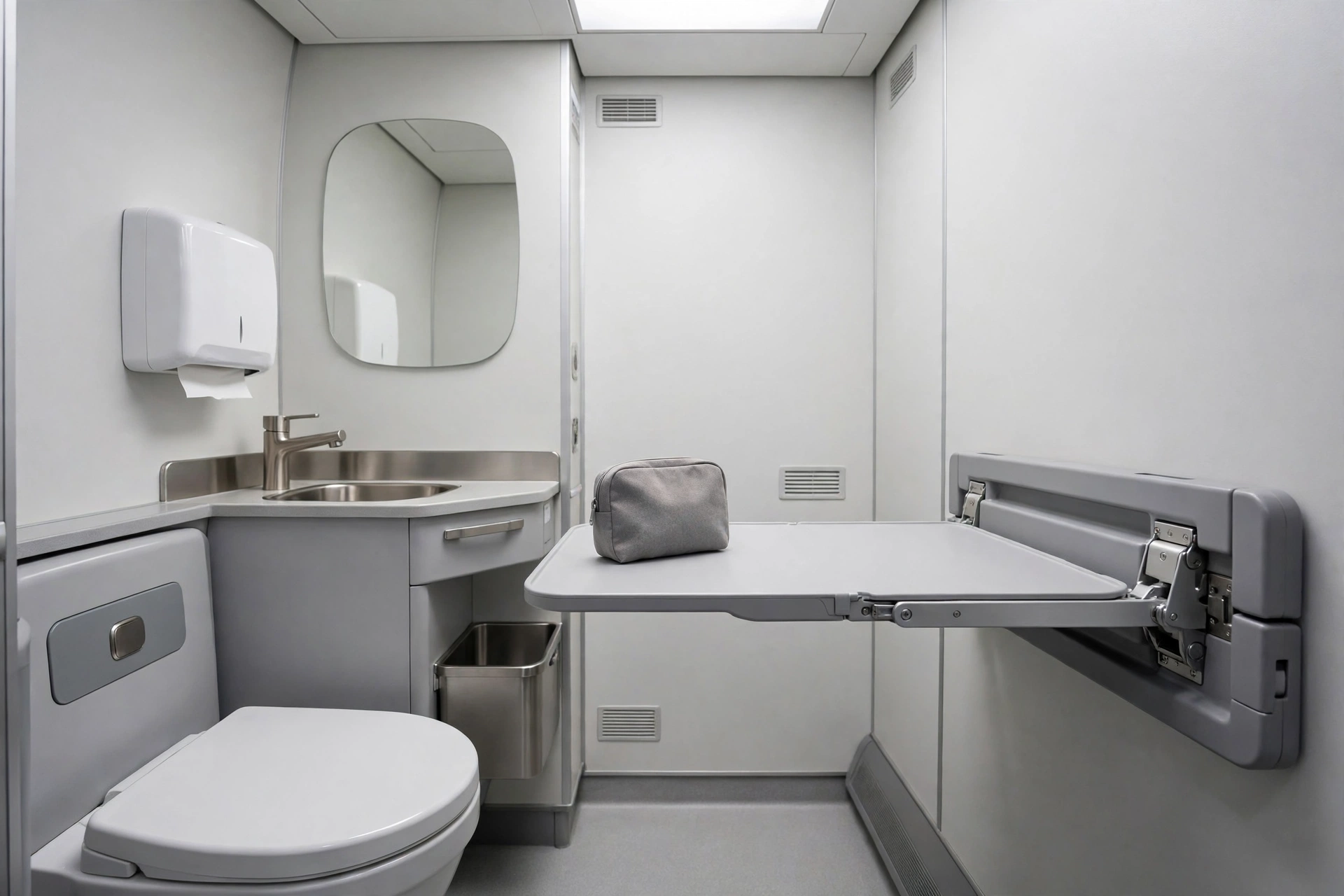
Changing-table availability varies by aircraft. Do not assume your flight has one, and do not assume that every lavatory on the plane has one.
A fold-down changing table is a flat panel that folds down from the wall of a lavatory. Look for a symbol showing a person changing a baby, or ask a crew member. On some flights, only one lavatory has a table, and it may not be the one nearest your seat.
Ask a crew member which lavatory has a changing table. That question saves a trip down the aisle with a baby in your arms and a pouch in your hand. If you are traveling with a partner, one adult can check while the other stays seated with the baby.
If the crew says there is no table on your aircraft, plan for the alternatives below before the diaper becomes urgent. Waiting until a baby is uncomfortable makes a small space feel smaller.
Work in the same order each time. A fixed order reduces the chance of leaving a clean diaper at your seat or a used wipe on the table.
If the table feels unstable, if your baby does not fit on it comfortably, or if you cannot keep a hand on your baby while reaching your supplies, stop and ask a crew member for another option. Forcing a change on a surface that is too small or unsteady is not safer than waiting for help or for a calmer moment.
No table does not mean no change. It means you need a surface you can control and a plan that keeps your baby supported.
The American Academy of Pediatrics notes that some parents use the closed toilet seat for a change, with a disposable pad on top and a hand on the baby at all times. This is a practical fallback, not a comfortable one.
Lay the pad on the closed lid, keep your baby centered on the pad, and keep one hand in contact with your baby throughout. Work with the pouch already open beside you, so you do not need to set your baby down to find a wipe. If your baby is active, squirming, or too large for the lid, this option becomes harder to do safely. In that case, ask the crew whether there is an open area where you can spread out a pad.
Do not use a tray table, a seat, or the floor of the aisle as a first choice. A tray table is a food surface for the next passenger, and a seat change puts soiled items close to other travelers and their belongings.
A toddler who can stand steadily and follow simple directions can sometimes be changed standing up. This can be easier than lying a long, active toddler on a short table.
Stand your toddler on the closed toilet lid, facing the wall, with a pad under their feet if the surface is slippery. Keep one hand on them. Pull their pants and diaper down, clean them, and pull the clean diaper and pants back up. This works best for a wet diaper and a calm toddler. For a soiled diaper, for a child who is unsteady, or for a child who is likely to climb or twist away, a lying change with full support is safer, even if it takes longer.
If you are changing a toddler at your seat because there is no other option and the crew has agreed, use a pad, keep the change as discreet as you can, and bag everything immediately. Do not leave soiled items on a seat or in a seat pocket while you finish dressing your child.
A blowout changes the order of the job. Deal with containment first, comfort second, and neatness last.
Remove the soiled outfit and put it straight into a disposal bag. Clean your baby, put on a clean diaper and outfit, and then deal with the bag. If you try to fold a soiled outfit neatly while holding a wet baby, you will usually end up with a second mess.
Bring at least one spare outfit for your baby and one spare top for you on any flight where a blowout is possible. That is especially worth doing on flights with a baby under one year old. A muslin or small towel in the pouch can help protect your clothes while you work.
For cloth diapers, fold the used diaper closed and put it in a wet bag. Do not try to rinse a cloth diaper in an airplane lavatory sink. The sink is small, and the space is shared.
Disposal is part of the change, not an afterthought. A soiled diaper left in a seat pocket, on a tray table, or on top of a lavatory trash bin creates a hygiene problem for the next passenger and for the crew who clean the aircraft.
Roll the diaper with the wipes inside, bag it, tie it, and put it in the lavatory trash. If the trash is full, ask a crew member where to put the bag. Do not leave it in the lavatory sink or on the floor.
The Centers for Disease Control and Prevention guidance on diaper changing stresses hand hygiene after a change, along with wiping from front to back and cleaning the changing surface when there are spills or leaks. In a plane lavatory, that means washing your hands with soap and water after the change, washing your baby’s hands when you can, and wiping the table or lid before you fold it away. If you use hand sanitizer or a wipe because the sink is difficult to reach with a baby in your arms, wash properly with soap and water at the next reasonable opportunity.
Some moments are not suitable for a lavatory trip, even if a diaper is wet.
Wait if the seat belt sign is on for takeoff, landing, or turbulence, and follow crew instructions. A change in a small lavatory during turbulence puts both you and your baby at risk of a fall. If you are already in the lavatory when turbulence starts, hold your baby securely, brace yourself, and wait until the aircraft steadies before trying to finish.
Do not start a change just before landing if the crew has asked passengers to return to their seats. A wet diaper can wait for the gate. A soiled diaper that is causing clear discomfort is a different case, but it still does not justify ignoring a safety instruction. Tell a crew member if you are concerned, and follow their direction.
Meal service can also make the aisle crowded. If you can, time a change for a quieter part of the flight, after the cart has passed and before the next service begins. That gives you a clearer aisle and less waiting outside the lavatory.
A few habits make a difficult job harder for everyone in the cabin.
Do not change a diaper on a tray table. It is a shared food surface, it is not stable for a baby, and it leaves other passengers with a surface they cannot trust.
Do not store a soiled diaper in a seat pocket, even for a few minutes. Seat pockets are not trash bins, and a bag can leak or be forgotten.
Do not bring loose items to the lavatory. A tube of cream, a loose diaper, and a pack of wipes are easy to drop in a small space. A pouch keeps them together.
Do not assume a changing table will be available on the return flight because it was available on the outward flight. Aircraft change, and so does lavatory layout. Ask again on each flight.
Use the lavatory first. A seat change should be a last resort, agreed with the crew, when there is no table, no suitable open area, and the change cannot wait. Use a pad, keep your baby supported, and bag everything at once.
No. Availability varies by aircraft, and you should not count on a table until a crew member confirms which lavatory has one. On some flights there may be no table at all.
Carry enough for the flight time plus a delay, with two in the small pouch for the change you are about to do. The rest can stay in the main bag at your seat, ready to refill the pouch.
A crew member can tell you which lavatory has a table, and can help with disposal or with finding a suitable space. Do not assume a crew member can hold your baby while you change a diaper. Ask what help is available on that flight, and plan to keep a hand on your baby yourself.
If your baby does not fit comfortably, or if the table does not feel stable with your baby on it, do not force the change. Ask the crew for another option, and consider a standing change for a steady toddler, as described above.
Wait at your seat if you can, rather than standing in the aisle holding a baby and a pouch. A short wait is usually easier than blocking the aisle during service or while other passengers are moving.
A diaper change on a plane is rarely neat, and it rarely follows the order you planned. The parts that matter are consistent: a change before boarding, a small pouch with everything for one change, a supported surface, a hand on your baby, and a clean, bagged disposal at the end. With that routine, the change becomes one short task in the flight, rather than the part you remember most.
Gate checking a stroller lets you keep it through the airport until the airline collects it near boarding. The stroller then travels in the…
Start with the decisions that would be difficult to fix at the airport: your baby’s documents, a suitable seating arrangement, feeding supplies and a…
The honest guide to the hardest flying age — and the strategy that makes it manageable.