Flying with little ones
Do Babies Need a Passport to Fly?
No, a baby does not need a passport for a domestic flight in the United States. Yes, a baby does need their own passport…
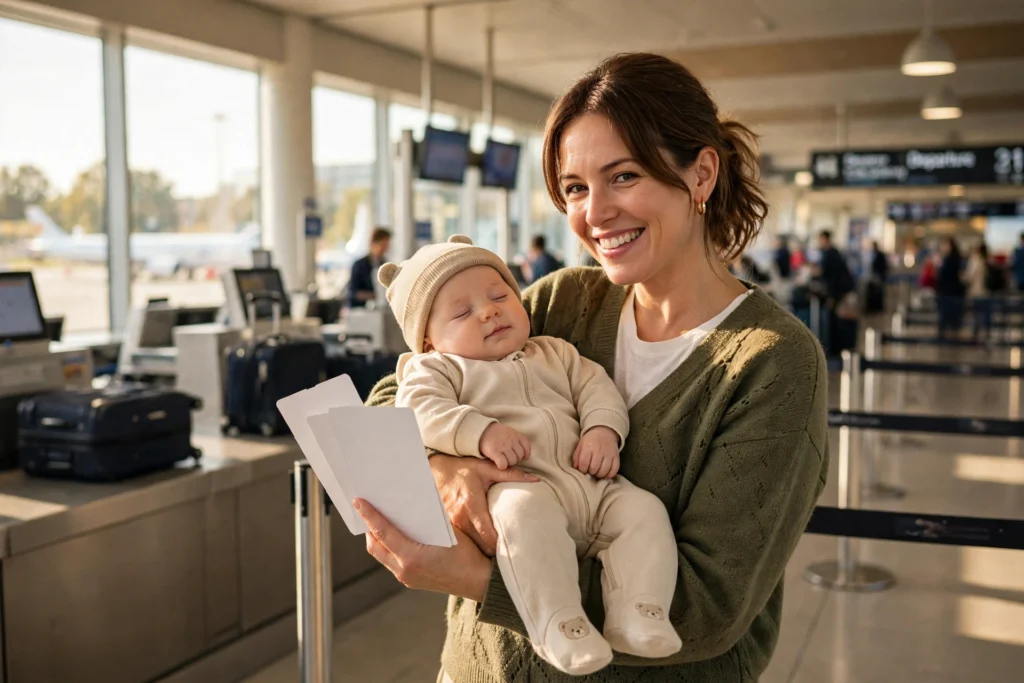
A baby must be on the flight reservation even if the baby will sit on your lap and will not occupy a seat. That single point causes most booking problems: a baby who is not listed cannot simply be carried on board, and a baby who is listed incorrectly can be stopped at check-in. This guide covers the booking process only: booking at the start, adding a lap infant later, what it costs, which documents to carry, and what to do about seats, car seats, bassinets, and baggage. For the flight itself, packing, and arrival, see the first-flight checklist linked at the end.
A child under 2 can usually travel in one of two ways. The first is as a lap infant, also called an infant-in-arms or lap child: the baby travels on an adult’s lap, without a separate seat. The second is in a purchased seat, in an approved child restraint or, for an older toddler, with the aircraft seat belt where the airline allows it.
Lap travel is cheaper and simpler, and it is the usual choice for a short domestic trip. A purchased seat is more comfortable on a long flight, it gives the baby a fixed place to sleep, and it is the only way to guarantee that an approved car seat can be used on board. The Federal Aviation Administration states that the safest place for a child under 2 on a U.S. airplane is in an approved child restraint system or device, not in an adult’s lap, because an adult’s arms cannot hold a child securely during unexpected turbulence. That is a safety recommendation, not a ban on lap travel: lap infants are permitted, and many families use that option.
The choice also affects price, baggage, and boarding documents, so make it before you start the booking rather than trying to change it at the airport.
Airlines use age on the date of travel, not age at the time of booking. A baby counts as an infant only while under 2 years old. Once a child reaches 2, a seat must be purchased.
If a child turns 2 during a trip, the rules change in the middle of the journey. American Airlines states that a child who turns 2 during a trip will need their own seat for the remainder of the trip. Delta states that a ticket must be purchased for a child who turns 2 during the trip. In practice, check the return flight separately: an outward flight as a lap infant does not guarantee that the return flight can also be a lap infant.
Only one lap infant is permitted per ticketed adult. This is a safety rule, not an airline preference. If one adult is travelling with two babies under 2, the second baby must have a purchased seat, in an approved restraint. The same limit applies when booking: one adult cannot be linked to two lap infants on the same reservation.
Newborn minimum ages differ by airline, so do not assume that a baby can fly from birth. American Airlines welcomes infants as young as 2 days old, but infants under 7 days old must have a doctor’s letter stating that they are medically cleared to travel, and the airline asks parents to contact Reservations in that case. Delta does not permit a newborn under 7 days old to travel unless accompanied by an approval letter from a physician who has physically examined the baby. Southwest defines a lap child as over 14 days old and under 2 years old. If your baby is very young, check your airline’s minimum age before you book, and ask your pediatrician as well.
Booking with a baby follows the same flow as booking for an adult, with three extra steps that must not be skipped.
First, add the baby as a passenger. During online booking, most airlines offer an infant or lap-child passenger type alongside adults and children. Select it, enter the baby’s full legal name exactly as it appears on the birth certificate or passport, and enter the date of birth. A nickname, a shortened name, or a wrong birth date can create a mismatch at check-in, especially on an international trip where the name must match the passport.
Second, link the baby to the correct adult. Booking systems ask which adult the lap infant is travelling with. That link matters for seating, for the one-lap-infant-per-adult rule, and for boarding documents. If two adults and one baby are travelling, link the baby to the adult who will actually hold the baby on the flight.
Third, sort out seats and requests before you pay. A lap infant does not get a seat, so do not expect a seat assignment for the baby. If you want a bassinet, a bulkhead row, or a specific seating arrangement for a car seat, request it during booking or as soon as possible afterwards, because bassinets and suitable rows are limited. If you are buying a seat for the baby, select a window seat where possible, and avoid exit rows: approved car seats are not permitted in exit rows or, on some airlines, in the rows immediately before or after an exit row.
If the baby has not been born yet, you cannot complete the infant passenger details, because the booking needs a legal name and a date of birth. In that case, book the adults first if the fare allows it, and add the baby once the baby is born and the details are known, using the after-booking route below. Do not invent a name or a birth date to force the booking through.

Adding a lap infant during booking is the easiest route. Adding one after booking is also possible on most major U.S. airlines, but the route depends on the airline and on whether the trip is domestic or international. Never assume that the route for one airline works for another.
On Delta, a lap-held infant must be added to the ticket for domestic travel, and for international travel the airline asks passengers to notify Delta Reservations so the child can be listed on the ticket. Delta also publishes a step-by-step guide for adding a lap-held infant, and its international infant fare is generally 10% of the adult fare plus international taxes or fees.
On American Airlines, a lap infant can be added on aa.com either during the booking process or after the trip is ticketed for domestic flights, including Puerto Rico, by going to the Passenger details page and selecting Add infant in lap. For international trips, American asks passengers to add the infant after the trip is ticketed, through the same Passenger details page. For international lap infants, American states that taxes and a percentage of the adult fare may apply; its infant page does not give a fixed percentage, so the exact amount is shown during the booking process rather than as a single published figure.
On Southwest, a lap child can be booked online at the same time as the adult reservation for both domestic and international travel, except when the reservation is purchased with Rapid Rewards points. To add a lap child to an existing reservation, or to a points booking, Southwest asks passengers to call 1-800-I-FLY-SWA. Once a lap child has been added to a Southwest reservation, changes to that reservation also require a call or a visit to a Southwest agent at the airport, rather than a purely online change.
For other airlines, including United and smaller carriers, the route is not covered in this guide because their current infant pages were not verified in the same way. Check the airline’s own infant or travelling-with-children page before you book, and if no online option is shown, call the airline before the day of travel. Adding a lap infant at the airport is a last resort, not a plan: it can work, but it depends on staff availability, on proof of age, and on whether the flight still has capacity for an additional infant.
When you add an infant after booking, have these details ready: the booking reference, the adult’s full name, the baby’s full legal name and date of birth, and, for an international trip, the baby’s passport details. After the change, check the updated confirmation before you close the page or end the call. The baby’s name and date of birth should appear on the confirmation, and for an international trip, an infant ticket or infant fare should be shown. If the confirmation still shows only the adults, the infant has not been added.
A booking made through a travel website, a travel agent, or a points program does not always carry infant details to the operating airline in the same way as a direct booking. If you booked through a third party and the baby is not shown on the airline’s own reservation, contact the operating airline directly with the airline booking reference, not only the third-party confirmation number.
Points bookings have their own limits. Southwest, for example, does not allow a lap child to be added online to a points booking, and asks passengers to call instead. American notes that a lap infant sitting on a lap may be added to domestic award tickets by a Reservations team member after booking. If you are using miles or points, add the infant through the airline’s own channel and confirm that the infant is listed before you rely on the booking.
Partner and codeshare flights need extra care. The airline that operates the flight applies its own rules, which may differ from the airline that sold the ticket. Southwest, for example, states that on a partner itinerary a seat must be purchased for a child from 14 days old to under 2 years old, even though the same child could travel as a lap child on a Southwest-operated flight. If any leg of the trip is operated by a different airline, check that airline’s infant rules for that leg, not only the rules of the airline that sold the ticket.
There is no single infant fare, and the figures below reflect the airline pages checked for this guide; confirm the fare shown during your own booking, because policies change.
For a lap infant on a domestic U.S. flight, the fare is usually free on major U.S. airlines. Delta states that infants under 2 can travel on the lap of an adult for free within the United States. Southwest states that a lap child can be carried free of charge domestically. That does not mean the baby travels without a record: the baby must still be added to the reservation, and proof of age may be requested.
For a lap infant on an international flight, expect taxes and fees even when the base fare is reduced. Delta states a general figure of 10% of the adult fare plus international taxes or fees. Southwest states that applicable government-imposed taxes and fees must be paid for international lap travel. American states that taxes and a percentage of the adult fare may apply, without giving a fixed percentage on its infant page. Because the percentage and the taxes vary by route and by airline, treat any figure quoted by another site as an example, and use the fare shown during your own booking as the figure that applies to your trip.
For a baby in a purchased seat, the price is a ticketed fare, not a lap-infant fare. Delta states that a child occupying a seat on a domestic flight requires a ticket and pays the applicable fare, and that a seated child must pay for an adult fare ticket on both domestic and international routes. Other airlines price a seated infant or child differently, sometimes as a child fare, so check the fare shown for a seat before you decide. Buying a seat also means the baby gets a boarding pass and, where the airline allows it, a checked-baggage allowance, which a lap infant usually does not get.
Documents are separate from the booking, and a correct booking does not replace them.
For a domestic flight in the United States, children under 18 travelling with an adult do not need identification for security screening, under the Transportation Security Administration’s rule. Airlines, however, may ask for proof of age for a lap infant, because age decides whether the baby qualifies as a lap infant at all. A birth certificate is the document most often used for that check. Southwest is specific about what it accepts: original or photocopied government-issued identification, such as a passport, a birth certificate, or a government-issued photo identification card. Southwest states that electronic versions such as screenshots or photos, and immunization records, are not accepted, and that if proof of age cannot be provided when asked, a ticket must be purchased for the child at the applicable fare. Carry the original or a photocopy, not only a phone photo, and keep it in hand luggage.
For an international flight, a baby needs their own passport book, even as a lap infant. A passport card is not valid for international air travel, and a birth certificate does not replace a passport book for a flight abroad. If you need the full passport rules, including how to apply for a baby, see the guide on whether a passport for a baby is needed to fly. If a child is travelling internationally with only one parent, with a grandparent, or with another guardian, some destinations and airlines may also ask for a consent letter from the absent parent or for custody documents. Check the destination’s rules before travel, rather than assuming that a passport alone settles the question.
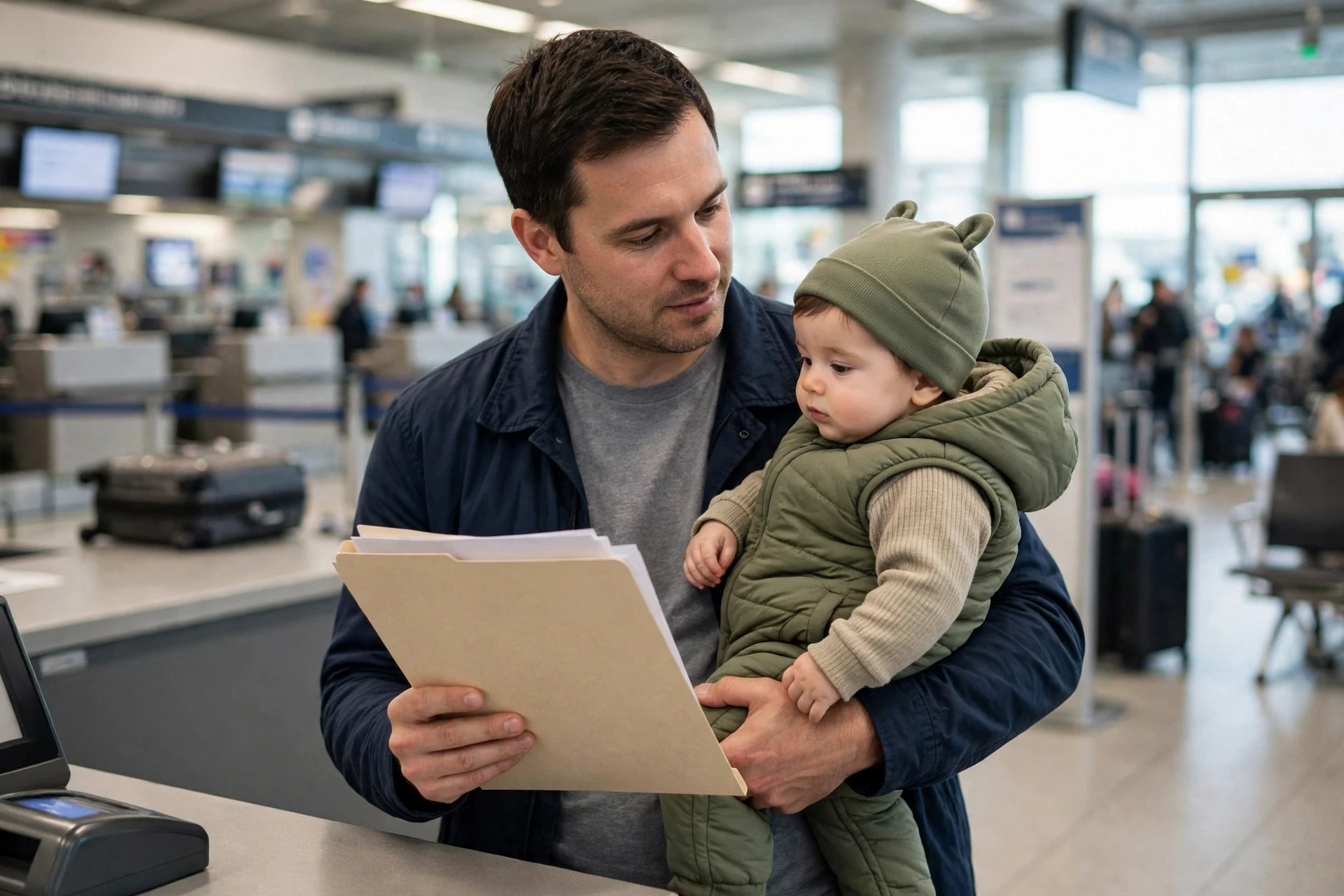
Keep all documents in a single folder in hand luggage. If a document is needed at check-in, at security, or at immigration, it should be reachable without opening a checked suitcase.
A lap infant does not need a seat, but the adults’ seat choices still matter. Lap infants cannot sit in exit rows, because the adult must be able to help in an evacuation. If you are travelling with a car seat, the same restriction applies, and the window seat is the preferred location, so the car seat does not block another passenger’s path to the aisle.
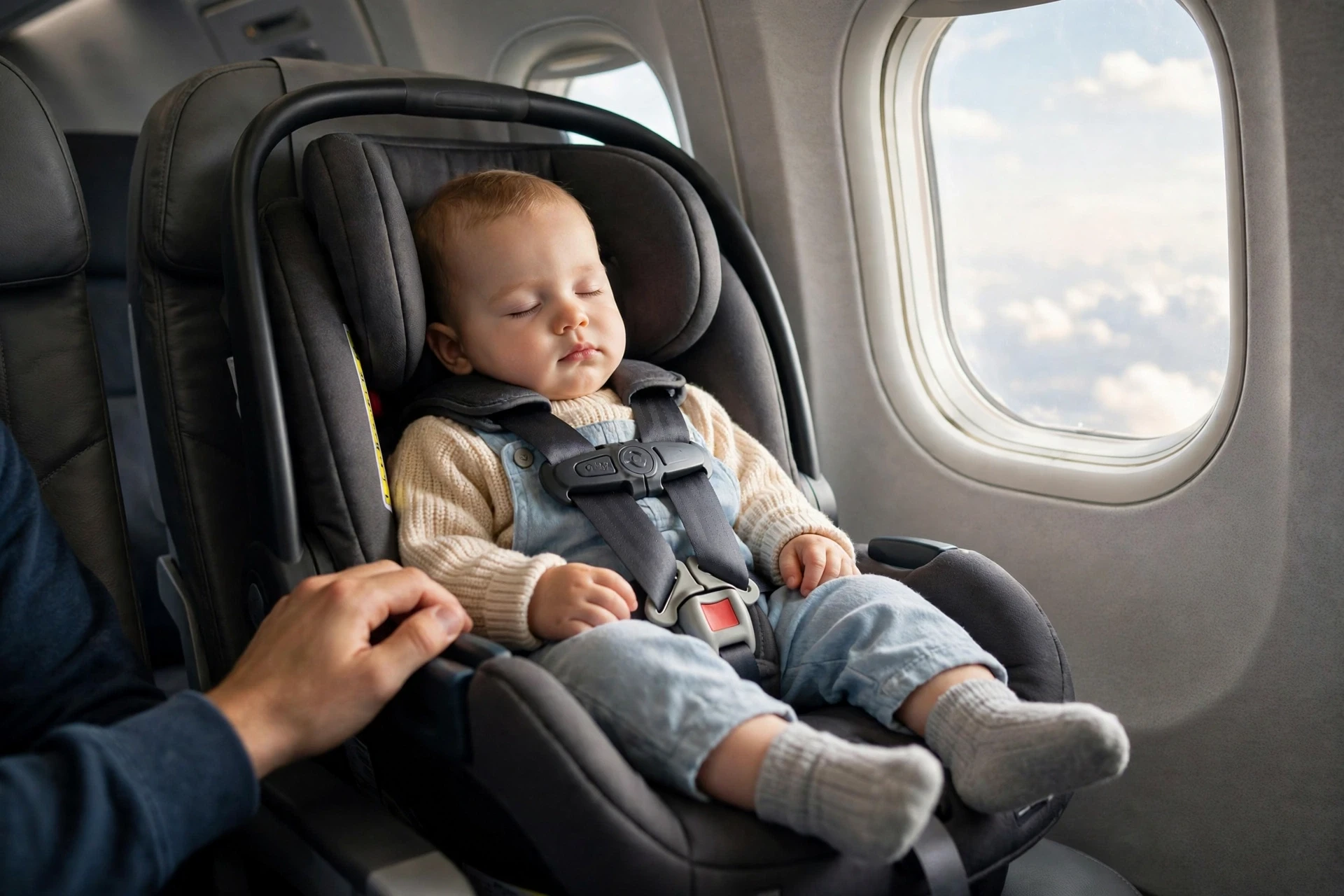
An approved car seat can only be used on board if the baby has a purchased seat, or if an empty seat next to the adult is available and the airline allows it. American states that to carry a safety seat on board, you must have bought a seat for the child or a seat must be available next to you; otherwise the gate agent will check the safety seat to the final destination. Buying the seat is the only way to guarantee that the car seat can be used.
To be approved for aircraft use, a car seat must carry a label stating that it is certified for use in motor vehicles and aircraft, or an equivalent foreign-government or United Nations approval. Booster seats are not permitted for use during taxi, takeoff, and landing. The Child Aviation Restraint System, known as CARES, is the only FAA-approved harness-type device for aircraft use, for children who weigh 22 to 44 pounds and are up to 40 inches tall, who can sit upright on their own in a forward-facing seat. CARES is approved for aircraft use only, not for use in motor vehicles. For the full car-seat rules, see the guide on travel car seats.
A bassinet is a separate request, not a seat. Bassinets are fitted to bulkhead rows on suitable aircraft, they are limited in number, and they have weight and length limits. Delta, for example, permits bassinet use for children under 25 pounds and up to 26 inches long, on widebody international flights or widebody domestic flights over 1,500 miles only, with a maximum of two bassinets per aircraft. Delta bassinet requests are made through Reservations before arriving at the airport, final confirmation is completed at the departure gate, and requests are subject to availability and cannot be guaranteed. Infants must still be held during takeoff, landing, and whenever the seat belt sign is on. Other airlines have different limits and different aircraft, so request a bassinet as early as possible and do not treat it as confirmed until the airline confirms it. For the full bassinet rules, see the guide on airplane bassinet seats.
A lap infant usually does not get a checked-baggage allowance. Southwest states this directly: a lap child may not check or carry on any baggage. The baby’s essentials therefore travel under the adult’s allowance, in the adult’s carry-on or personal item.
Strollers and car seats are treated separately from ordinary baggage on most major U.S. airlines. Southwest states that an accompanying customer may check one stroller and one car seat or child restraint system per child free of charge. Delta directs passengers to its infant and children’s items guidelines for carry-on items, including child restraint seats, strollers, and diaper bags. Many families gate-check the stroller at the aircraft door, which keeps it available through the airport. Confirm the collection point with staff, because it can be at the door, at oversize baggage, or on the belt depending on the airport. For the gate-check process, see the guide on gate-checking a stroller.
A diaper bag is usually carried as the adult’s personal item or as an additional baby item, depending on the airline. Do not assume that a lap infant gets a separate cabin bag: check the airline’s baggage page for the exact allowance, and pack the baby’s essentials in the bag that stays with you, not in a checked suitcase that could be delayed.
At check-in, confirm that the baby is listed on the reservation before you head to security. On Southwest, a lap child does not get a boarding pass, but does need a Boarding Verification Document, which can be accessed after check-in online or through the mobile app, or printed at the airport on the day of travel at a kiosk or the ticket counter. Proof of age is still required. On other airlines, an international lap infant is issued a ticket, and a domestic lap infant appears on the adult’s reservation. If the baby is not listed at check-in, go to the ticket counter rather than trying to board with only the adult’s boarding pass.
At security, the Transportation Security Administration uses modified screening for children 12 and under. Parents carry infants through the metal detector, and children are not separated from their parent or guardian during screening. Strollers, car seats, baby carriers, and other child equipment must go through the X-ray machine, or be inspected by hand if they do not fit. Formula, breast milk, toddler drinks, and baby food are allowed in quantities over 3.4 ounces as medically necessary liquids, do not need to fit in a quart-sized bag, and must be declared at the start of screening and removed for separate screening. For the full feeding rules, see the guide on flying with breast milk and formula.
Family boarding, where offered, lets families with young children board earlier, which helps with settling a car seat or a bassinet request. Boarding order varies by airline and is not a booking right, so do not rely on it for a tight connection. Allow extra time between flights when travelling with a baby: Delta itself suggests allowing a little extra time between flights for rest or bathroom breaks.
The most common booking mistakes are easy to avoid once they are named.
A name or birth-date typo on the infant record should be corrected before the day of travel, through the airline’s manage-booking page or by phone. A mismatch is harder to fix at the airport, and on an international trip it can prevent boarding.
A baby who was not added to the booking at all should be added as soon as the omission is noticed, not at the gate. If the flight is full, ask the airline whether infant capacity remains, so an early addition is safer than a late one.
A change of flight with a lap infant may require a phone call even when adult-only changes can be made online. Southwest, for example, asks passengers to call to change a flight with a lap child. Check the change route before you assume that an online change covers the baby as well.
A cancellation should also cover the infant record. If the adult’s flight is cancelled or rebooked, confirm that the infant record moves with it, especially on an international trip where an infant ticket was issued. If the adult is rebooked onto a different airline or a partner flight, recheck the infant rules for the new operating airline.
A baby who turns 2 between booking and travel, or during the trip, needs a new fare calculation. Do not leave the original lap-infant record in place and hope that no one notices at the airport: the age is judged on the date of each flight, and the return flight may require a purchased seat.
Before you book, decide lap infant or purchased seat, check the airline’s newborn minimum age, and check the age of the baby on every flight date, including the return.
During booking, add the baby as an infant or lap-child passenger, enter the full legal name and date of birth exactly, link the baby to the correct adult, and request a bassinet or a suitable seat arrangement if needed.
After booking, check the confirmation for the baby’s name and date of birth, check the infant fare or ticket for an international trip, and note the route for any later change: online, by phone, or at the airport.
Before the airport, pack proof of age and, for an international trip, the baby’s passport book and any consent or custody documents that apply. Keep them in hand luggage, check in early, and confirm at check-in that the baby is listed.
For the flight itself, including what to expect on board, see the guide on a first flight with a baby.
A baby needs to be listed on the reservation even as a lap infant. On a domestic U.S. flight, a lap infant usually travels free, but still needs to be added to the adult’s ticket. On an international flight, a lap infant is usually issued a ticket and pays taxes plus a percentage of the adult fare. A baby in a purchased seat always needs a ticket.
Add the baby during online booking by selecting the infant or lap-child passenger type, entering the baby’s full legal name and date of birth, and linking the baby to an adult. After booking, use the airline’s manage-booking page where available: American allows domestic additions during or after booking through Passenger details, and international additions after ticketing. Southwest allows online addition at booking, but asks passengers to call to add a lap child to an existing reservation or to a points booking. Delta asks passengers to notify Reservations for international lap infants.
Sometimes, but do not rely on it. Airport addition depends on staff availability, on proof of age, and on whether the flight can still carry another infant. Add the baby before the day of travel whenever possible, and use the airport only as a fallback if the booking was missed.
It varies by airline and route. Delta generally charges 10% of the adult fare plus international taxes or fees. Southwest charges applicable government-imposed taxes and fees for international lap travel. American states that taxes and a percentage of the adult fare may apply, without giving a fixed percentage on its infant page. Use the fare shown during your own booking as the figure that applies to your trip.
The baby needs a purchased seat for the flights on or after the second birthday. American states that a child who turns 2 during a trip will need their own seat for the remainder of the trip, and Delta states that a ticket must be purchased for a child who turns 2 during the trip. Check the return flight separately, and reprice the booking before travel.
Yes, but only one baby can be a lap infant. The second baby must have a purchased seat, in an approved child restraint. The one-lap-infant-per-adult rule is a safety rule, and it applies on every flight.
A lap infant is cheaper and simpler, especially for a short domestic flight. A purchased seat is more comfortable on a long flight, and it is the only way to guarantee that an approved car seat can be used. The FAA states that an approved restraint, not a lap, is the safest place for a child under 2. Choose based on flight length, budget, and whether you want to use a car seat on board.
For a domestic U.S. flight, carry proof of age, usually a birth certificate, in case the airline asks, even though security screening does not require identification for children under 18 travelling with an adult. For an international flight, the baby needs their own passport book. If only one parent is travelling, check whether a consent letter or custody documents are also required for the destination.
The booking is the part of a baby’s first flight that is easiest to get wrong and easiest to get right. Add the baby to the reservation, check that the name and birth date are correct, confirm the fare for a lap infant or a purchased seat, and carry the documents that prove age and, for an international trip, identity. Done in that order, the rest of the journey can focus on the baby, not on the booking.
No, a baby does not need a passport for a domestic flight in the United States. Yes, a baby does need their own passport…
You can change a diaper on a plane, and the airplane lavatory is the place to do it. The usual plan is simple: change…
Gate checking a stroller lets you keep it through the airport until the airline collects it near boarding. The stroller then travels in the…