Flying with little ones
How to Book a Flight With a Baby and Add a Lap Infant
A baby must be on the flight reservation even if the baby will sit on your lap and will not occupy a seat. That…
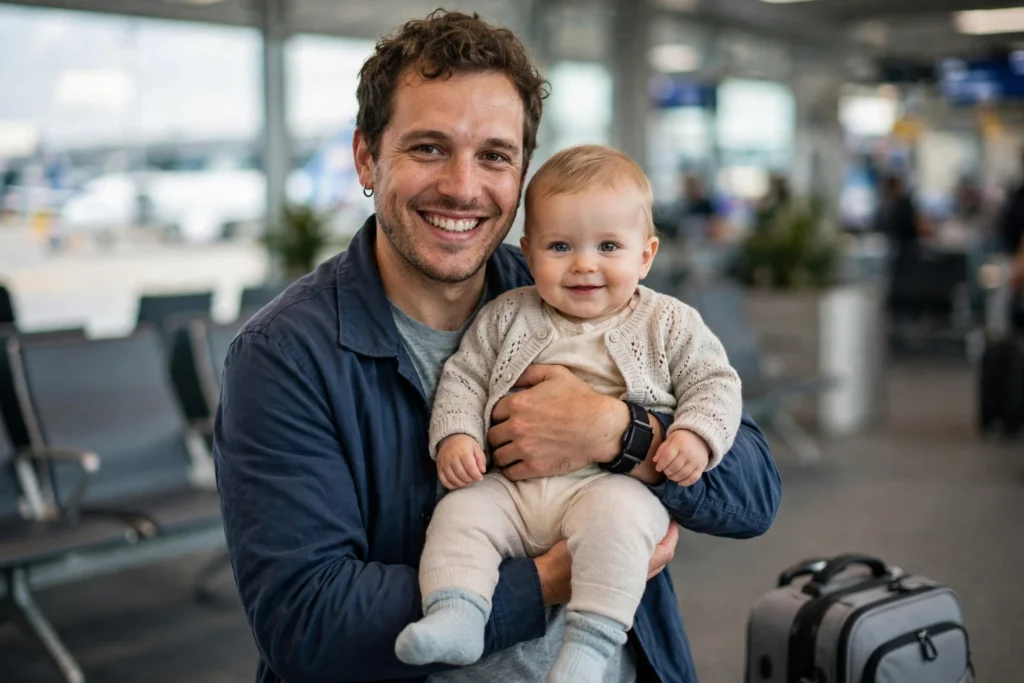
Dress your baby in soft layers that you can add or remove, with easy access for diaper changes and feeding. That single rule covers almost every flight, because the temperature in a plane can vary, especially if you are stuck waiting on a runway, and because a baby who is comfortable at boarding may be too warm or too cool an hour later. The American Academy of Pediatrics gives the same starting advice for flying with a baby: dress them in layers, choose outfits that make diaper changing in a small space easier, and pack a change of clothes, or even two, for spills during diaper changes or feedings.
This guide covers the outfit itself: what each layer should do, how to judge whether your baby is warm enough, what changes if your baby sleeps or sits in a car seat, and what to pack as a backup. It does not try to prescribe one outfit for every baby, because babies differ in age, in how warm they run, and in whether they are held, in a bassinet, or in a car seat.
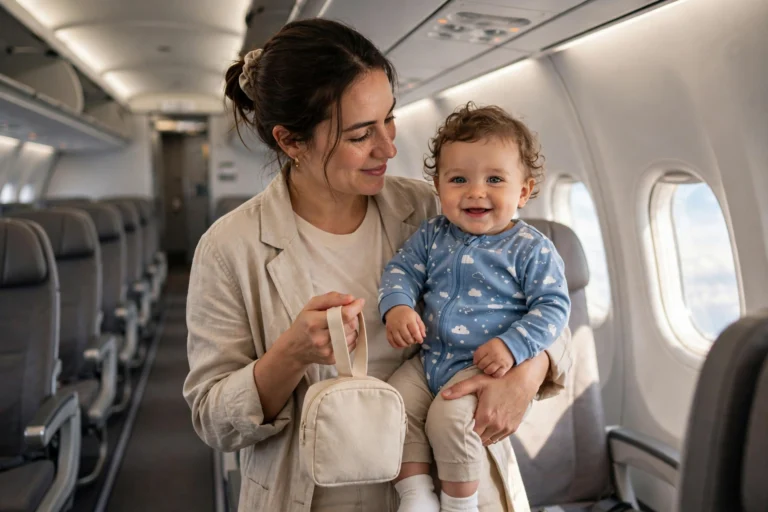
Think in three parts. The base layer sits against the skin and should be soft and breathable, such as a cotton onesie. The middle layer adds warmth and can come off, such as soft pants with a light sweater or cardigan. The outer layer is only for the cold parts of the journey, such as a light jacket for the airport and for a cool cabin, which can be taken off once you are settled.
Layers work because they let you adjust without changing the whole outfit. If the cabin feels cool, add the cardigan. If your baby feels warm after boarding, remove it and leave the base layer. Trying to get the temperature right with one thick outfit leaves no adjustment, and a baby who is overdressed cannot easily cool down.
A useful check is the chest or the back of the neck, not the hands and feet. Hands and feet often feel cool in babies even when the rest of the body is warm. If the chest feels warm and dry, the clothing is probably about right. If the skin is sweaty or damp, or the cheeks are flushed, remove a layer and check again after a few minutes.
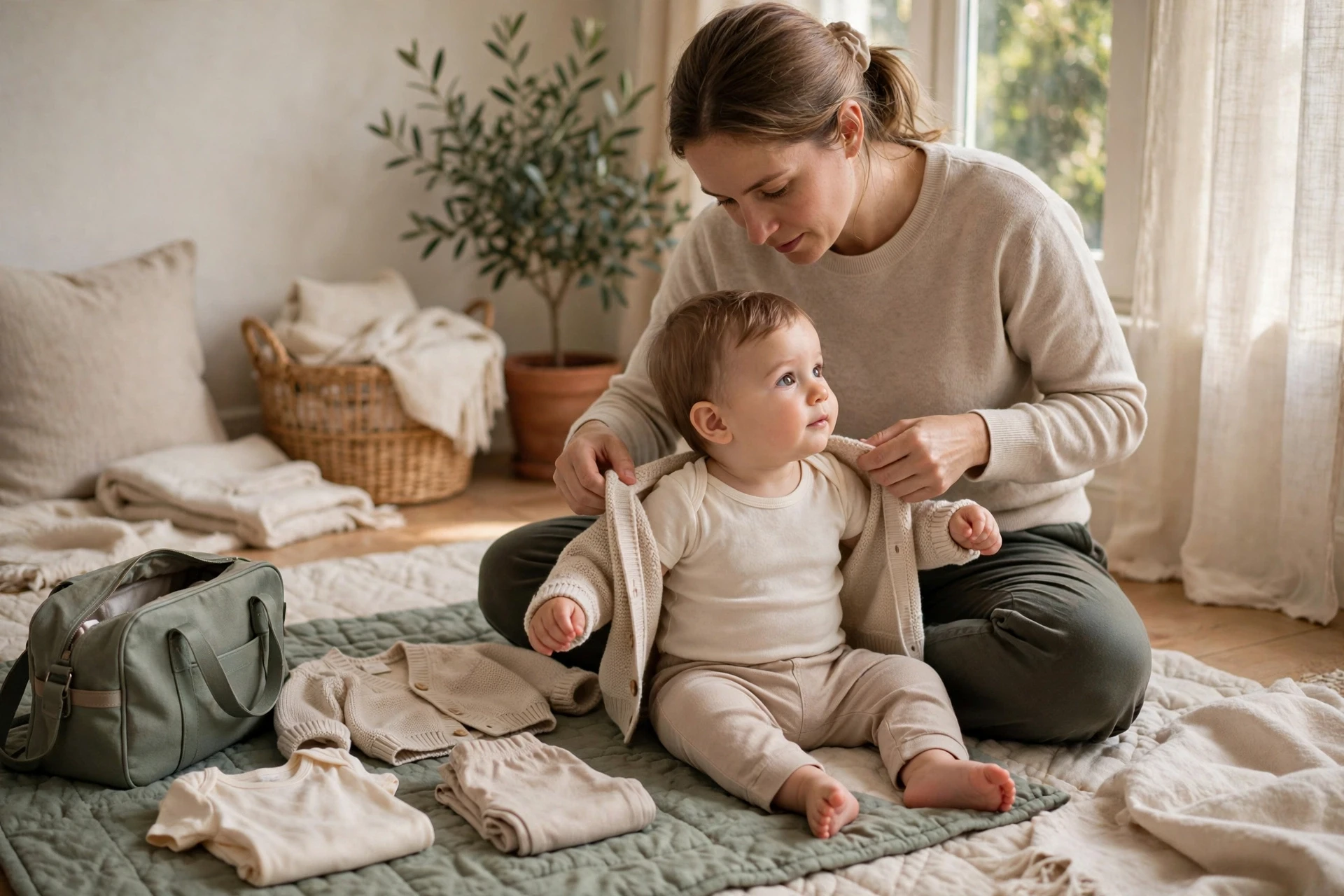
Choose a soft, breathable fabric that does not irritate the skin. Cotton is the usual choice, and bamboo and merino wool are also used for the same reason: they breathe rather than trapping heat and moisture against the skin. Avoid stiff fabrics, rough seams, and outfits that pull or bunch when your baby moves. A onesie with snaps or a zip works well as a base, because it stays in place and does not ride up when you lift your baby.
The middle layer should be easy to put on and take off while you are seated, with your baby on your lap. A cardigan or a zip-up top is easier in that position than a pullover that has to go over the head. Soft pants with an elastic waist are easier than jeans or anything with a stiff waistband, and they are more comfortable when your baby sits for a long time.
Bring one light outer layer even on a warm-weather trip, because airports, air conditioning, and cabins can all feel cooler than the destination. A light jacket or fleece is enough for most flights. A heavy winter coat belongs in the overhead bin or under the seat for the coldest parts of the journey, not necessarily on the baby for the whole flight, and it should never go under a car seat harness, as explained below.
Soft socks or soft booties are the practical choice on a plane. They keep feet warm without restricting movement, and they stay on better than loose shoes. Hard-soled shoes add nothing on a flight for a baby who is not walking through the terminal, and they can be uncomfortable when your baby kicks against a seat. If your baby is walking in the airport, soft-soled shoes are a reasonable middle ground.
A hat is useful outdoors and in a cold airport, but it is not needed inside a warm cabin, and it should not be used to keep a sleeping baby warm indoors. Keep accessories simple: no loose scarves, long cords, dangling strings, or small items that could come off and be put in the mouth. Anything your baby wears should stay in place when you lift, carry, and settle them, without needing constant adjustment.
On a plane, the outfit is also a working garment. Diaper changes happen in a small lavatory, often with the baby on a fold-down table or, if there is no table, on a closed toilet seat with one hand on the baby at all times. An outfit that opens quickly from below, with snaps or a zip, makes that change far easier than an outfit with many buttons, a back opening, or layers that all have to come off.
For the lavatory procedure itself, see how to change a diaper on a plane. The clothing point that matters here is preparation: dress your baby so that only the lower half needs to be opened, and keep the changing supplies where you can reach them without standing up and opening a bag in the aisle.
If you breastfeed, a top that lifts or opens at the front is easier than a dress or a top that has to be pulled up from below, especially when you are seated with a seat belt fastened and a baby in your arms. The same principle applies to bottle feeding: clothing should not get in the way of holding the baby close, and a spare top for you is worth packing, because spit-up and spills land on the adult as well as on the baby.
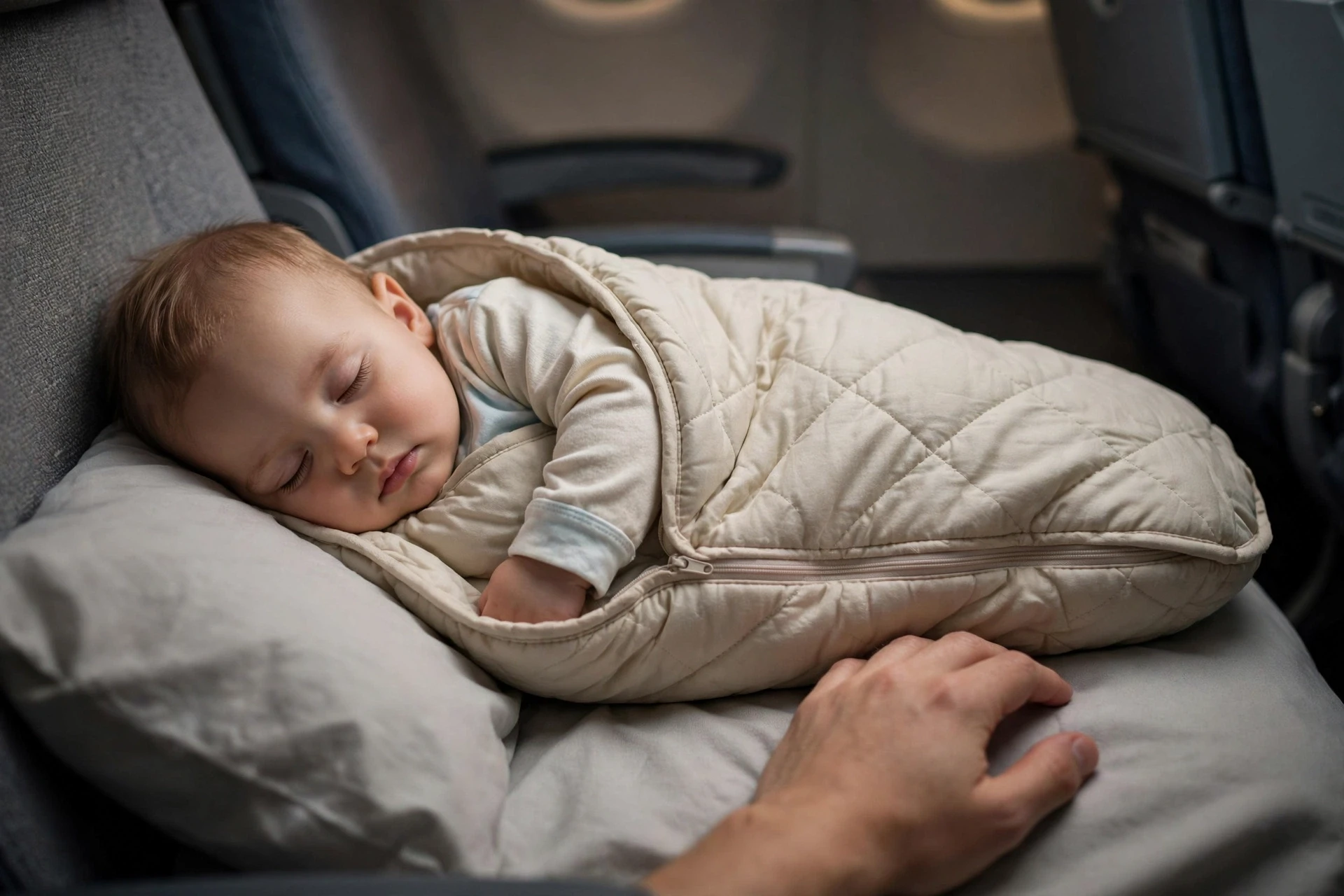
Sleep changes the clothing rules, because a sleeping baby cannot tell you that they are too warm, and because loose bedding is a separate safety question from warmth. The American Academy of Pediatrics advises that a baby should be dressed in no more than one layer more than an adult would wear to be comfortable in the same environment, and that overheating should be avoided during sleep. That rule is a ceiling, not a target: one extra layer at most, and less if the cabin is warm.
A wearable blanket, often called a sleep sack, is the usual way to add warmth for sleep without loose bedding. It goes over the base layer, usually leaves the arms free, and cannot ride up over the face the way a loose blanket can. If your baby sleeps in an airline bassinet, the same principle applies: the Academy’s flying guidance notes that a bassinet surface should be firm and flat with no blankets, sheets, pillows, or stuffed animals. Warmth for a bassinet sleeper should therefore come from clothing and a sleep sack, not from added bedding.
For an overnight flight, dressing your baby in their usual sleepwear can help, because the familiar outfit is part of the sleep routine. That still means checking the chest after the baby falls asleep and removing a layer if the skin feels sweaty. Do not put a hat on a sleeping baby indoors to keep them warm, and do not cover the face or head with a blanket.
For the bassinet rules themselves, including size and weight limits, see the guide on airplane bassinet seats.
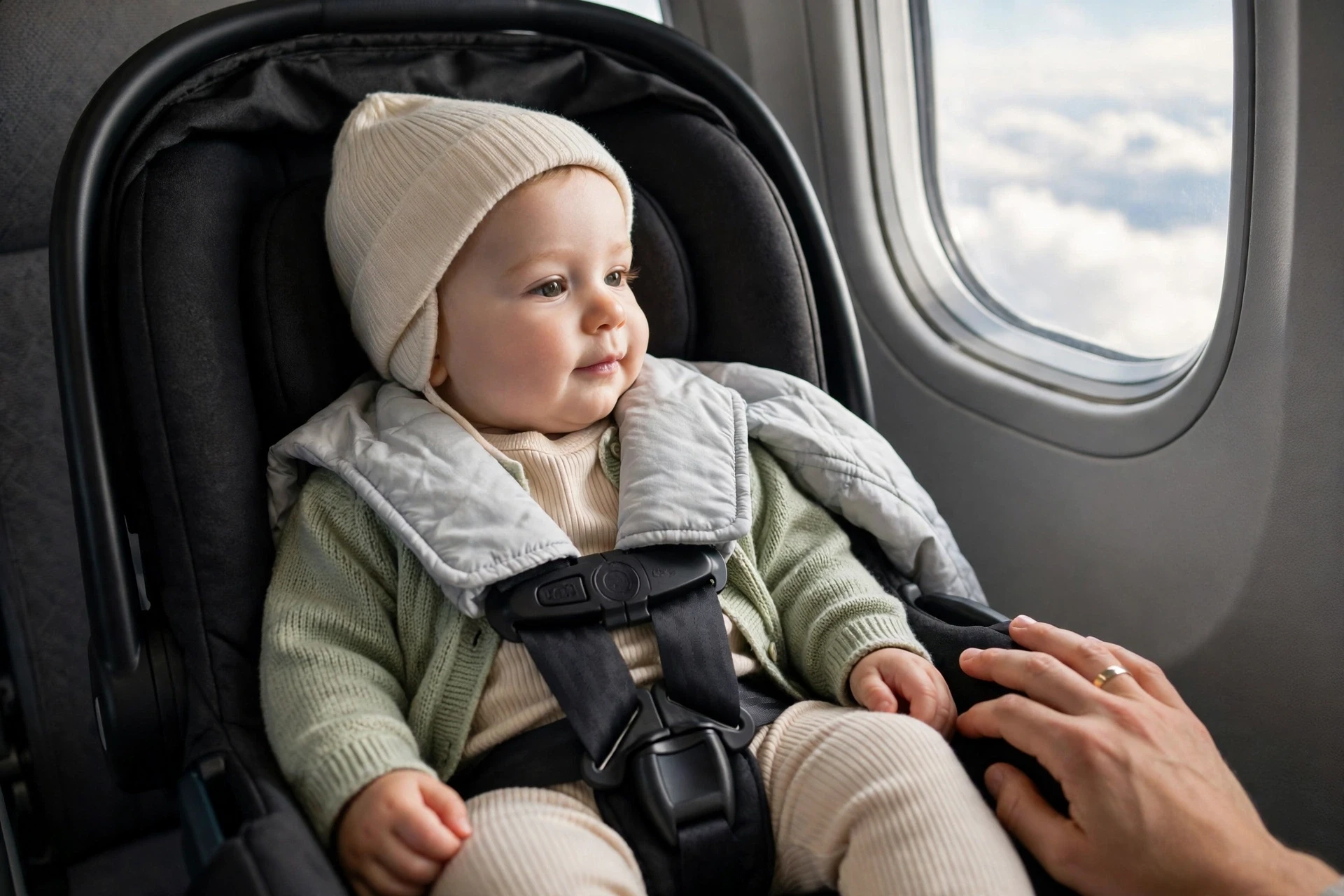
A baby in a car seat needs thinner clothing under the harness than a baby held in arms. The American Academy of Pediatrics explains why: bulky clothing, including winter coats and snowsuits, can compress in a crash and leave the straps too loose to restrain the child. The recommended approach is to dress the baby in thinner layers, buckle the harness snugly, and then wrap a coat or blanket around the baby over the buckled harness straps if extra warmth is needed.
That rule matters on a plane as well, because the same harness principle applies in an aircraft seat. Dress your baby in the base and middle layers for the car seat, check that the harness is snug with no slack at the shoulders, and add warmth over the top only after buckling. A puffy snowsuit should not be the layer under the straps, even on a cold-weather trip.
For the full car-seat rules, see the guide on travel car seats.
Pack at least two spare outfits for the baby in your carry-on, not in a checked suitcase. The Academy’s flying guidance suggests a change of clothes, or even two, and plastic bags for soiled diapers and clothing. Two spares cover the common pattern: one change for a leak or spit-up, and a second in case a delay stretches the journey or the first spare is used early.
Pack the spares in your one-bag diaper bag, where you can reach them without opening a suitcase in the aisle. Each spare should be a complete outfit, not just a top: onesie, pants or sleeper, and socks. A spare outfit that still needs a missing piece is no help at 30,000 feet.
Also pack a spare top for yourself, a small blanket for warmth on your lap, and plastic bags for soiled clothing. The blanket is for warmth and comfort while you are awake and holding your baby, not as loose bedding for a sleeping baby in a bassinet. If you are travelling to a cold destination, pack the heavier outdoor clothing in the carry-on as well, so your baby is dressed for arrival without waiting for checked luggage.
Avoid a brand-new outfit that your baby has never worn. A flight is a poor time to discover that a seam irritates, a zip catches, or a fabric causes a rash. Dress your baby in something they have already worn at home and that you know fits and washes well.
Avoid overdressing out of worry about the cold. A baby in too many layers sweats, becomes uncomfortable, and may be harder to settle. It is easier to add a layer you packed than to cool down a baby who is already sweating in a thick outfit.
Avoid outfits that need constant adjustment: slipping shoulder straps, a waistband that rolls, a hat that falls over the eyes, or shoes that come off and get lost under the seat. On a plane, every adjustment means disturbing a settled baby or standing up in a crowded cabin.
Avoid dressing your baby for the destination rather than for the journey. A baby flying to a hot climate still spends hours in an air-conditioned airport and cabin, and a baby flying to a cold climate still spends hours seated indoors. Dress for the cabin, carry the destination clothing in the bag, and change after landing if needed.
These are examples, not prescriptions, and they should be adjusted for your baby’s age and for how warm or cool your baby usually runs.
Soft cotton onesie, soft pants, socks, and a light cardigan in the bag. One spare outfit of the same kind. This covers a cool cabin and a spill without extra bulk.
Soft sleepwear as the base, a light sleep sack if your baby sleeps in one at home, socks, and a cardigan for boarding. Check the chest after your baby falls asleep and remove a layer if the skin is damp.
The same cabin layers as above, plus a warm jacket and hat packed in the carry-on for arrival. Put the jacket on after landing, not under a car seat harness, and add it over the buckled straps if your baby travels in a car seat at the destination.
Yes. Soft pajamas are a reasonable choice, especially for an overnight flight, because they are comfortable, allow movement, and fit the sleep routine. Choose a pair with easy access for diaper changes, and keep a spare set in the carry-on.
A hat is useful outdoors and in a cold airport. Inside a warm cabin it is usually unnecessary, and a sleeping baby should not wear a hat indoors to stay warm. Warmth for sleep should come from clothing and a sleep sack, not from a hat.
No, not for the flight itself. Soft socks or booties are enough for a baby who is held or in a car seat. Soft-soled shoes make sense only if your baby will walk through the airport.
At least two complete spare outfits in the carry-on, plus a spare top for yourself and plastic bags for soiled clothing. Two spares cover a spill and a delay without needing checked luggage.
The outfit that works on a plane is the one you can adjust without a struggle: soft layers, easy openings, nothing bulky under a harness, and a spare set within reach. Dress for the cabin you are sitting in, check the chest rather than the hands, and let sleep warmth come from clothing rather than loose bedding. Done that way, clothing stops being something to worry about and becomes one less thing to manage on the flight.
For the rest of the journey, including what to expect on board, see the guide on a first flight with a baby.
A baby must be on the flight reservation even if the baby will sit on your lap and will not occupy a seat. That…
No, a baby does not need a passport for a domestic flight in the United States. Yes, a baby does need their own passport…
You can change a diaper on a plane, and the airplane lavatory is the place to do it. The usual plan is simple: change…